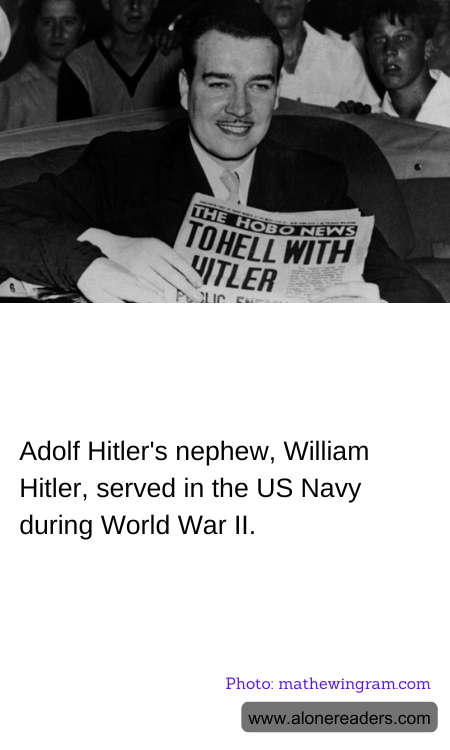
William Patrick Hitler, the nephew of Adolf Hitler, indeed has an intriguing and lesser-known story, particularly during World War II. Born in Liverpool, England, in 1911 to Alois Hitler Jr., Adolf Hitler's half-brother, and his Irish-born wife Bridget Dowling, William's life trajectory took a dramatically different turn from his infamous uncle.
Prior to the war, William moved to Germany in an attempt to benefit from his uncle's rising power. However, estranged by the Nazi regime's ideologies and not receiving the favoritism he had hoped for, William fled to the United States in 1939, where he embarked on a speaking tour to warn about his uncle's plans and the Nazi threat. His lectures included insights into Hitler’s regime, utilizing his unique familial connection to highlight the evils of Nazi Germany.
By the time the United States entered World War II after the attack on Pearl Harbor, William Patrick was moved to further distance himself from his uncle's dark legacy. In 1944, after a period of investigation by the U.S. government regarding his background and intentions, he enlisted in the United States Navy. Serving as a Pharmacist’s Mate until his discharge in 1947, William participated in the fight against the Axis powers, directly opposing the fascist regime led by his uncle.
After the war, William Hitler changed his surname to Stuart-Houston, likely an attempt to sever all visible ties to his notorious relative and build a new life. He settled in Patchogue, New York, where he lived a relatively quiet life, raising a family and working in a blood analysis laboratory until his death in 1987.
William’s story is a stark example of the complex human narratives that emerge from the shadow of historical titans. His decision to actively fight against Hitler’s regime speaks volumes about his personal convictions and the possible inner conflict he experienced being related to one of history's most reviled figures. His life serves as a reminder of the unpredictable ways in which individuals navigate their familial ties and personal beliefs in times of moral crisis.
