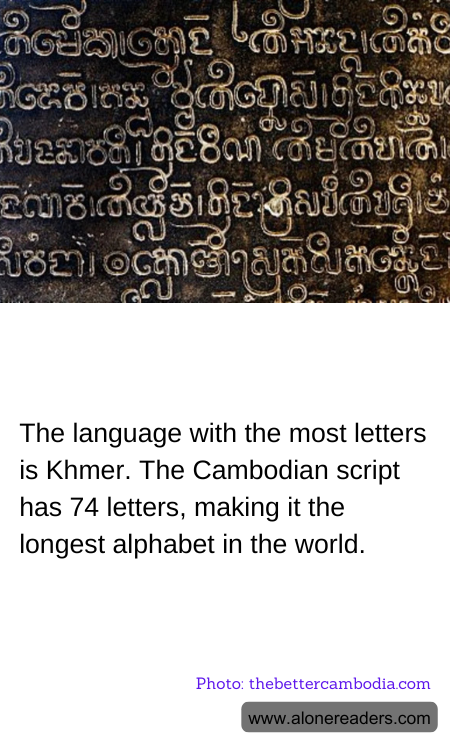
The Khmer language, spoken by millions in Cambodia, is distinguished not only by its rich history and cultural significance but also by its complex script. This script, known as Aksar Khmer, holds the title for the longest alphabet in the world, featuring a grand total of 74 letters. This expansive alphabet is an integral part of the linguistic identity of the Khmer people and plays a crucial role in the preservation of Cambodia’s literary and cultural heritage.
The Khmer script is derived from the Brahmi script of ancient India, a lineage it shares with many other Southeast Asian scripts. Over the centuries, it evolved significantly, becoming the intricate system in use today. The script consists of 33 consonants and 23 vowels that can be combined into various clusters, with vowels appearing before, after, above, or below the consonant. This allows for a vast array of sounds and tone marks, adding to the complexity of the language and its written form.
Learning to read and write in Khmer can be challenging due to the script's complexity and the phonetic nuances it must convey. The large number of characters can be daunting for new learners, but they are essential for expressing the subtle distinctions in tone and pronunciation that Khmer language entails.
The preservation and continued use of the Khmer script are thanks to Cambodia’s strong cultural traditions, which have been maintained despite various historical upheavals. The script is a source of national pride and cultural identity. It is used not only in literature but also in everyday communication, administrative work, and education, ensuring its survival and continuing relevance.
Overall, the Khmer script is not just a means of communication but a vital link to Cambodia’s historical and cultural legacy. Its status as the world’s longest alphabet only adds to its uniqueness and importance, marking it as a remarkable aspect of human linguistic achievement.
