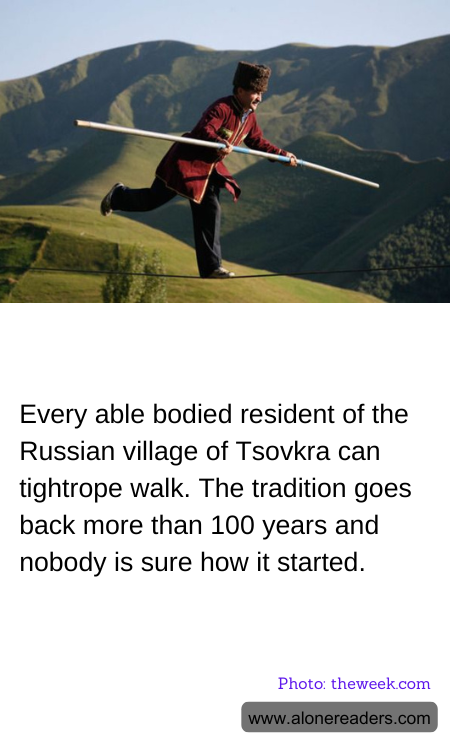
In the heart of the North Caucasus region of Russia lies the quaint village of Tsovkra, where an extraordinary tradition has been thriving for over a century. Every able-bodied resident of this small, picturesque village possesses the remarkable skill of tightrope walking, a practice so deeply ingrained in their culture that it has become a defining feature of their identity.
Tightrope walking, or funambulism, involves walking along a thin wire or rope, typically elevated and without any form of safety net. It is an art that requires not only immense physical skill and balance but also a high degree of mental fortitude. In Tsovkra, children are introduced to the rope at a very young age, learning the basic techniques from their elders who have mastered the craft through decades of practice. The skill is passed down through generations, preserving and perpetuating the tradition.
Despite its long-standing nature, no one in Tsovkra can pinpoint exactly how or why tightrope walking became such a significant part of their local heritage. Some believe it could have started as a form of entertainment, a way to celebrate local festivals or gatherings. Others speculate it may have had practical origins, perhaps a method for traveling between hills or across rivers in the rugged terrain of the Caucasus. Over time, these stories have woven themselves into the fabric of Tsovkra’s cultural narrative, becoming as legendary as the tightrope performances themselves.
The village’s tightrope walkers often perform during local festivals and are a major attraction, drawing visitors from across Russia and beyond. These performances are not only a display of individual skill but also a communal event that strengthens bonds within the community. Moreover, they embody the villagers' resilience and their ability to maintain balance in all facets of life – both literally and metaphorically.
Remarkably, the tradition of tightrope walking has also instilled a sense of pride and unity among the villagers. It has enabled them to build a unique identity and offer something no other village in Russia can – a literal interpretation of walking through life’s ups and downs on a slender line, with only one’s skill and focus as safeguards. As modernization encroaches upon traditional lifestyles, the people of Tsovkra continue to uphold this captivating aspect of their heritage, ensuring it survives for future generations to admire and embrace. In Tsovkra, tightrope walking transcends the physical, becoming a poignant symbol of cultural perseverance and the timeless human spirit.
