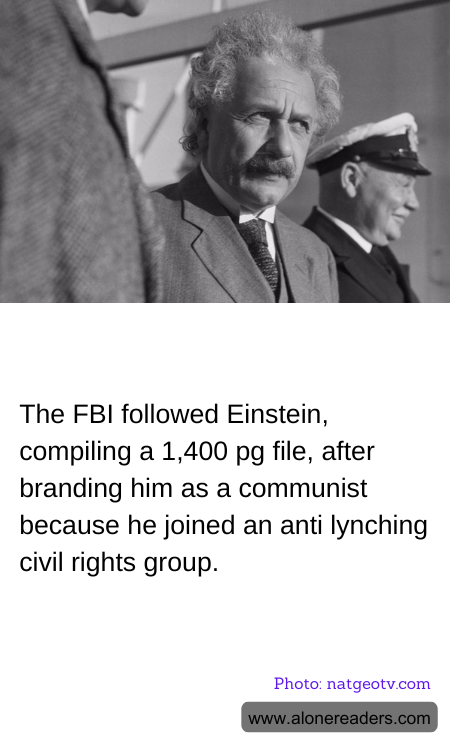
Albert Einstein, one of the greatest physicists known for developing the theory of relativity, was also recognized for his vocal political activism, which drew as much attention as his scientific contributions, particularly from the FBI. Under the directorship of J. Edgar Hoover, the FBI developed a substantial interest in Einstein's activities beyond academia, primarily due to his affiliations with various organizations and movements perceived as radical at the time.
In the heat of the Cold War era, the atmosphere in the United States was rife with suspicion and paranoia about communism. Einstein’s outspoken opposition to fascism, advocacy for civil rights, and his support for pacifist and anti-nuclear stances led to suspicions about his political alignments. One particular association that attracted significant attention was his support for an anti-lynching law, reflecting his active engagement in the civil rights movement. His endorsement of this campaign, along with numerous associations with peace and anti-racism groups, placed him under the FBI’s radar.
The FBI opened a file on Einstein in 1933, the same year Hitler came to power in Germany which prompted Einstein to emigrate to the U.S. This file grew to a staggering 1,400 pages over the years, documenting a wide range of activities and associations that the Bureau deemed subversive or communist-influenced. This included surveillance records, letters, and statements from informants. The large scope of this file indicates the level of attention and resources that were devoted to monitoring Einstein, epitomizing the FBI's broader efforts to keep tabs on individuals and groups they considered threats to national security.
Despite these investigations, no concrete evidence could ever establish that Einstein was a communist or a spy. His involvement in various movements was primarily driven by his commitment to social justice and his strong moral principles against racism and violence. Einstein’s case is a prominent example of how the fear of communism during the early to mid-20th century led to invasive surveillance of intellectuals and activists whose ideas were seen as radical or anti-establishment.
This surveillance of prominent figures like Einstein is reflective of a broader historical context in which fear often drove policy and action, leading to violations of privacy and freedom of association. It underscores a period where ideological conformity was enforced so rigorously that even celebrated intellectuals were not immune from government scrutiny. Today, Einstein’s FBI file serves as a poignant reminder of the complex interplay between science, politics, and ideology in American history.
