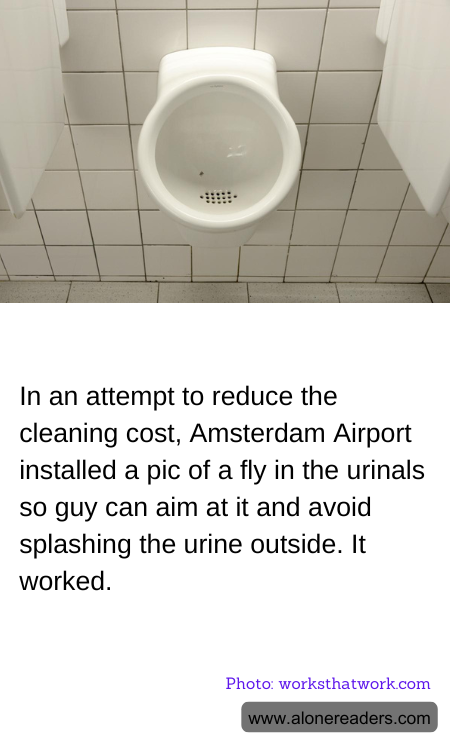
Amsterdam Airport Schiphol, one of Europe's busiest airports, faced a unique challenge related to maintaining cleanliness in men's restrooms. The cost of cleaning these areas was becoming increasingly significant, due to frequent urine splashing and spillage on floors around urinals. This not only made for an unpleasant experience but also escalated the maintenance expenses. In a creative attempt to tackle this issue, the airport management deployed a rather ingenious behavioral nudge: the placement of a fly decal in the urinals.
The idea was simple yet surprisingly effective. By installing a small image of a fly at an optimal spot in each urinal, men were subconsciously encouraged to aim at the target. This game-like element led to more focused urination, significantly reducing spillage. The concept behind this approach is rooted in psychology, particularly in directing attention and behavior subtly. Men, either consciously or subconsciously, aimed at the fly, thus minimizing unwanted splashing and keeping the restroom floors cleaner.
This innovative solution demonstrated a critical point: that small, cost-effective changes could profoundly impact behavior and lead to significant economic savings. It not only helped in reducing the frequency and need for cleaning, thereby lowering costs, but brilliantly illustrated how behavioral psychology could be applied in practical, everyday problems. The fly in the urinal concept has been so successful that it has been adopted in various other airports and public facilities around the world, praising its simplicity and undeniable efficacy.
Moreover, the introduction of such a nudge has broader implications regarding user experience and facility management. It emphasizes the importance of intuitive design in public spaces that guides user behavior in subtle ways. Airports, frequently challenged with high traffic and the need for maintaining stringent cleanliness standards, can take cues from these minor yet impactful strategies to enhance efficiency.
Overall, Amsterdam Airport Schiphol's approach not only solved a practical problem but also set a precedent for how small, creative solutions could lead to significant improvements in managing public facilities. It stands as a testament to the power of innovative thinking in operational challenges, proving that sometimes the simplest interventions are the most effective.
