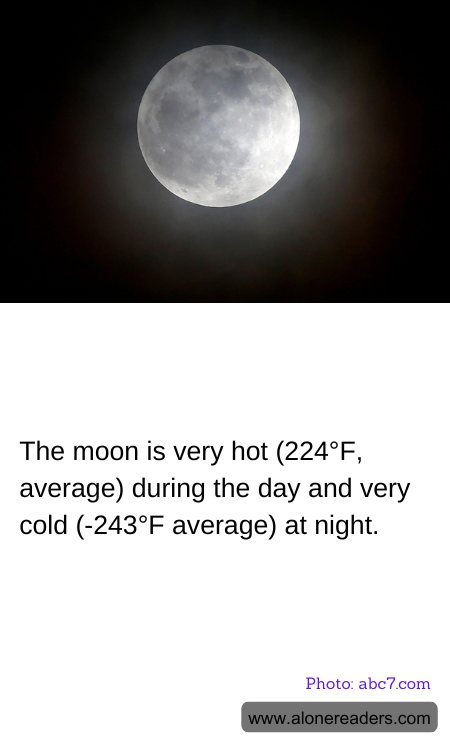
The moon, Earth's only natural satellite, exhibits one of the most extreme climates in our solar system, primarily because it lacks an atmosphere similar to Earth's that can moderate temperatures. This absence of atmospheric protection leads to drastic temperature fluctuations that are among the most severe of any celestial body known to us.
During the lunar day, temperatures on the moon's surface can soar to an average of 224 degrees Fahrenheit (106 degrees Celsius). This intense heat is due to the unfiltered solar radiation that strikes the moon’s surface. Since there is no atmosphere to diffuse or block some of the sun's rays, the surface gets extremely hot. This temperature can be likened to a hot summer day in the sunniest, driest deserts on Earth, but far exceeding any temperature records set on our planet.
Conversely, lunar nights, which last about 14 Earth days, experience temperatures that plummet to an average of -243 degrees Fahrenheit (-153 degrees Celsius). Without the sun’s rays to heat the surface and no atmosphere to retain any heat during the night, the temperature drops dramatically. This severe decrease makes the moon's night among the coldest environments in our solar system.
Such extreme conditions pose significant challenges for lunar exploration and potential colonization. Spacecraft and future moon bases must be specially equipped to handle these radical temperature changes, ensuring that electronic equipment and human occupants can maintain optimal temperatures for functioning. This involves the use of advanced insulation technologies, heating elements, and possibly leveraging the moon's regolith (soil) itself as a thermal barrier.
Studying these temperature extremes and their implications not only aids in preparing for future missions but also helps scientists understand other celestial bodies with similar harsh climates. This research can provide insights into the adaptability of technology—and perhaps life itself—in some of the most inhospitable environments imaginable.
