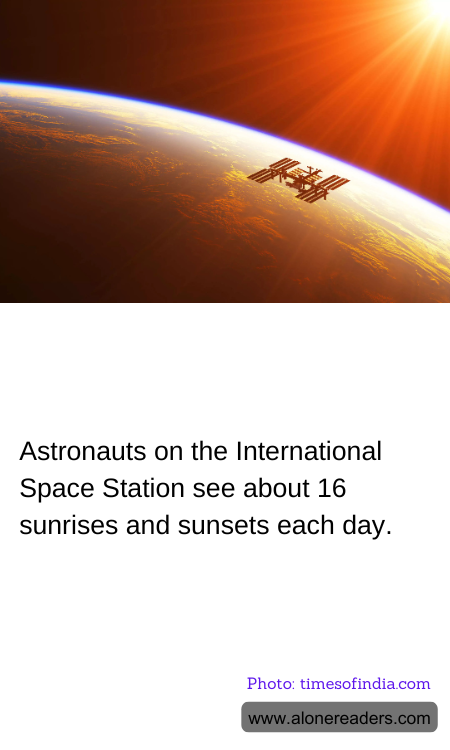
Aboard the International Space Station (ISS), astronauts experience a phenomenon that is utterly foreign to those of us bound by Earth's gravity: witnessing approximately 16 sunrises and sunsets each day. This unique spectacle is a function of the ISS's high orbital speed and its position relative to the Earth and Sun. Orbiting the planet at an incredible speed of about 28,000 kilometers per hour (17,500 miles per hour), the ISS completes a full orbit around Earth approximately every 90 minutes. This rapid orbit means that for the crew aboard the ISS, day and night cycle every 45 minutes, giving them the opportunity to see the Sun rise and set multiple times during a 24-hour period.
This fast-paced transition between day and night not only offers a visual spectacle but also has significant impacts on the biological clocks of the astronauts. The human body is tuned to a roughly 24-hour day-night cycle, known as the circadian rhythm. The frequent shifts between daylight and darkness on the ISS can disrupt this internal clock, potentially leading to sleep disturbances and other physiological changes. To mitigate these effects, the lighting inside the ISS is carefully controlled to mimic the natural progression of day and night on Earth as closely as possible, helping astronauts maintain a regular sleep-wake cycle.
The experience of watching so many sunrises and sunsets is often highlighted by astronauts as one of the most profound and awe-inspiring aspects of space travel. Each event brings with it a rapid change in light and a breathtaking view of the Earth's curvature, with the Sun illuminating the thin line of the atmosphere, creating vivid hues that paint the beginning and the end of each short day. This unique perspective not only provides stunning visuals but also deepens the astronauts' appreciation of Earth’s beauty and the fragile appearance of its atmosphere, underscoring the need to protect our planet.
In addition to its aesthetic and psychological impacts, the observation of Earth from the ISS during these transitional periods provides valuable scientific data. Researchers utilize the information gathered during these times to study atmospheric composition, weather patterns, and climate change. The insights gained from such studies are crucial for improving our understanding of environmental processes and enhancing the accuracy of meteorological forecasts on Earth.
Thus, the experience of witnessing numerous sunrises and sunsets from the ISS encapsulates more than just the novelty of frequent transitions between day and night—it stands as a reminder of our planet’s vulnerability, a trigger for scientific curiosity, and a source of profound inspiration for astronauts and those who follow their journeys from below.
