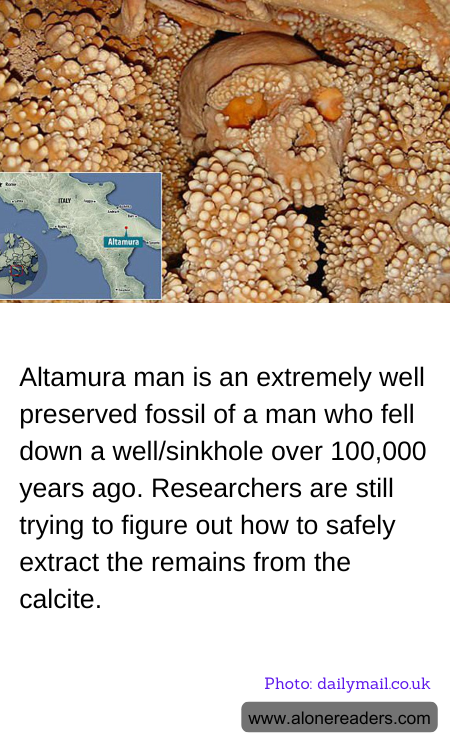
Altamura Man represents a unique and compelling glimpse into the ancient past, dating back over 100,000 years. The discovery of his remarkably preserved fossil in a limestone cave near Altamura, Italy, in 1993 was somewhat of an accident. It occurred when a team of speleologists exploring the cave system encountered the remains embedded in the formations of calcite, a mineral derived from the slow deposition of calcium carbonate. Given the degree of preservation and the context of the finding, it is believed that the individual, a Neanderthal, fell into a well or sinkhole and was subsequently encased in this calcite layer that has both preserved and entrapped the remains over millennia.
The Altamura skeleton is considered one of the most complete and best-preserved Neanderthal skeletons ever found but also presents a particular challenge for extraction and study. Unlike many paleoanthropological discoveries where bones may be separate or fragmented, the skeleton here is enmeshed within solid rock, making conventional excavation methods risky and potentially destructive. Researchers must devise a careful and innovative approach to extract the remains without compromising their integrity. This includes the possible use of micro-excavation techniques or advanced imaging technology that can visualize and analyze the bones in situ before any physical contact is made.
This find is incredibly significant for the study of Neanderthals, offering potential new insights into aspects of their physical characteristics, health, and perhaps even their culture and social behavior given the context of their entrapment and preservation. In addition to morphological studies, modern techniques in paleogenomics could enable scientists to extract and sequence DNA from the bones, provided that they can be accessed in a way that prevents contamination. Such genetic information could broaden our understanding of Neanderthal lineage, their genetic diversity and their interactions with contemporary Homo sapiens.
The continued study of the Altamura Man also promotes a wider appreciation of the extensive time scale of human ancestry, reinforcing the connections and distinctions within the Homo genus. As technology and methodologies in paleoanthropology evolve, the hope is not only to uncover more about this particular individual's life and times but also to gain broader insights into the narrative of human evolution. The efforts to safely recover Altamura Man continue to be a focus of international interest and scientific study, embodying the challenges and rewards of deep time archaeology.
