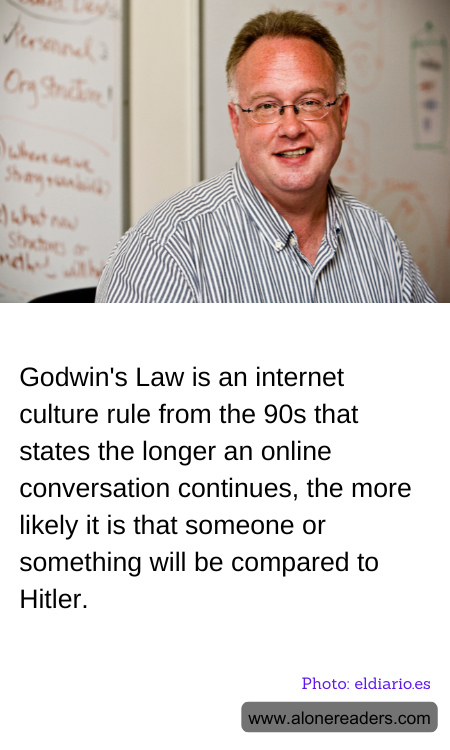
Godwin's Law, coined by American attorney and author Mike Godwin in 1990, serves as one of the earliest observations about the escalating nature of online discourse. According to Godwin, as an online discussion grows longer, the probability of a comparison involving Hitler or Nazis approaches one. This adage has been circulating through various Internet circles since the early days of Usenet forums, and it reflects a broader understanding of how heated discussions tend to devolve.
The rule is not meant to be taken scientifically but rather as a cautionary guideline about the level of rhetoric and hyperbole that can emerge in electronic communications when disagreements occur. Comparing someone or something to Hitler or Nazis is often seen as an endpoint for meaningful discussion, as it tends to signal a breakdown in reasoned debate and a move toward emotional argumentation. This is frequently referred to as the reductio ad Hitlerum, indicating that once such a comparison is made, the conversation has likely lost any semblance of rationality and mutual understanding.
In broader application, Godwin’s Law emphasizes the importance of keeping discussions focused and on-topic, and used as a reminder to avoid hyperbolic comparisons that could derail meaningful exchange. With time, it has also been morphed into a broader meme in online encounters, where it is invoked to acknowledge the absurdity and frequency of Nazi comparisons in discussions ranging from politics and ethics to mundane topics.
Godwin himself has commented on the usage of his law, particularly how it might be employed as a tool for reflection rather than merely an internet quip. He advocates for its use in examining whether analogous comparisons to Nazis in discussions are thoughtful or merely inflammatory. Thus, the cultural footprint of Godwin’s Law extends beyond highlighting the pitfalls of online debate; it also underscores a broader cultural tendency to leap quickly to extreme comparisons in lieu of more measured argumentation. In the dynamic landscape of internet interactions, this law serves as a perennial reminder of the need for civility and relevance in our digital engagements.
