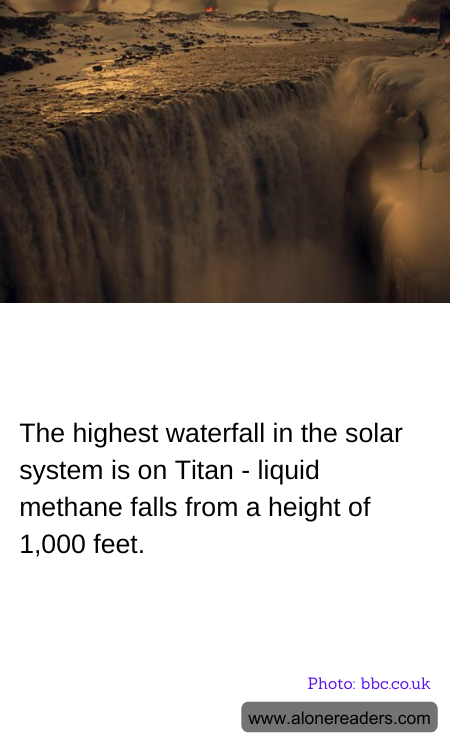
On Saturn's largest moon, Titan, an extraordinary natural feature claims the title for the highest waterfall in our solar system, dramatically reshaping our understanding of extraterrestrial geologic and atmospheric phenomena. This waterfall isn't comprised of water as we know it, but rather liquid methane, which cascades from an astonishing height of about 1,000 feet. Titan's dense, nitrogen-rich atmosphere and extremely cold temperatures, which can plummet to around -290 degrees Fahrenheit, allow methane to exist in liquid form, enabling such a waterfall to occur.
The discovery of methane waterfalls on Titan adds a fascinating layer to what scientists know about this moon, which has been a subject of intense interest since the Cassini-Huygens mission, a collaboration between NASA, the European Space Agency, and the Italian Space Agency, provided detailed images and data. Titan is often compared to an early Earth, providing clues to how our planet might have looked before life emerged, due to its thick atmosphere and surface liquids.
Despite its distance from the Sun, Titan's atmosphere is thick enough to support weather systems similar to those on Earth, including wind and rain, creating rivers, lakes, and seas of methane and ethane. This creates a landscape both alien and strangely familiar, with erosion and sedimentary processes that sculpt its icy surface into familiar forms like dunes, plains, and channels, and yes, even waterfalls.
Understanding these processes not only illuminates the possibilities of geology on other worlds but also raises intriguing questions about the potential for life in environments radically different from our own. The presence of complex organic molecules in Titan's atmosphere, which are the building blocks for life as we know it, hints at the moon’s potential to host or support life forms adapted to its extreme conditions.
As we continue to explore our solar system, Titan stands as a reminder of the incredible diversity and beauty of nature, extending well beyond our Earthly boundaries. The methane waterfalls serve as a striking symbol of this, reminding us of the dynamic and ever-changing nature of planetary bodies. They underscore the importance of continued exploration and study, which could provide vital insights into not only the formation and development of celestial bodies but also the potential habitability of other worlds. With missions like the upcoming Dragonfly drone by NASA, set to launch in the 2030s to further explore Titan’s surface and chemical composition, our understanding of these extraordinary phenomena will only deepen, possibly opening new chapters in the story of our universe.
