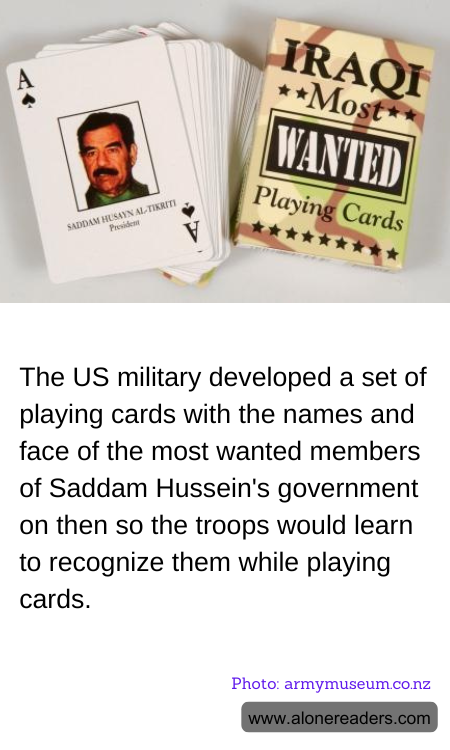
In 2003, during the Iraq War, the United States military introduced an innovative tool designed to aid soldiers in identifying key members of Saddam Hussein's regime: a deck of playing cards. Each card featured the name and a photo of a government official along with their official position, making the deck an easy-to-distribute, easily accessible means of spreading vital intelligence among troops. The deck consisted of 55 cards, including jokers, with each suit representing a different type or level of official within the regime.
The face cards and aces were assigned to the highest-value targets, with Saddam Hussein naturally being the Ace of Spades. Other prominent figures included his sons, Uday and Qusay Hussein, who were depicted as the Ace of Hearts and Ace of Clubs, respectively. This system turned the mundane activity of playing cards into a continuous learning and recognition exercise, ensuring that soldiers could familiarize themselves with the faces and names of those they were tasked with capturing or monitoring.
The idea derived from similar strategies used in past conflicts, where visual aids were employed to help soldiers identify important figures or equipment of the enemy. By integrating this into a common leisure activity such as card playing, the military capitalized on the natural human propensity for visual learning.
The cards were also emblematic of a broader psychological operation aimed at undermining the regime's aura of power and control. Distributing these cards to troops not only served a practical military purpose but also played a part in the symbolic dismantling of Hussein's rule. It communicated to Iraqi officials and citizens alike that the regime's days were numbered.
The "most wanted" deck quickly captured the public's imagination and gained significant media attention. Reproductions became popular memorabilia and were sold widely, turning them into a cultural phenomenon. This widespread distribution helped to cement the deck's place not only in military history but also in popular culture, illustrating how a simple, creative idea could be leveraged to achieve multiple objectives in a complex conflict.
