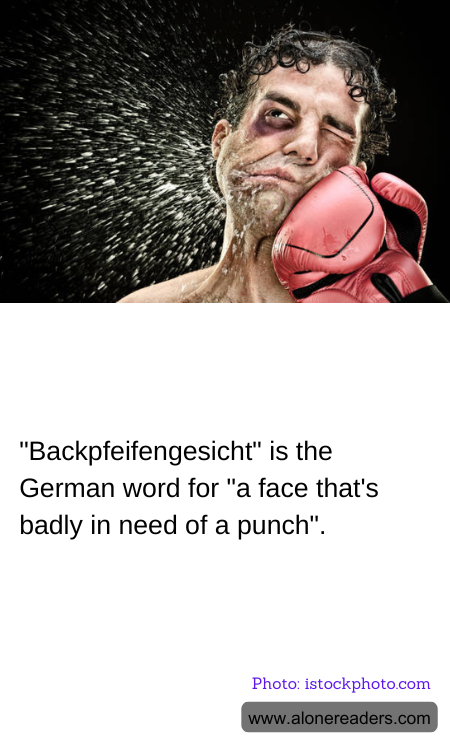
The German language is renowned for its compound words that often encapsulate highly specific emotions or situations, which other languages might need a full sentence to describe. One such intriguing term is "Backpfeifengesicht," a word that might sound bewilderingly complex to non-native speakers but provides a peculiarly precise description of a notion many of us recognize. Literally translating to "slap-face" or more colloquially, "a face badly in need of a punch," this term uniquely combines "Backpfeife" (slap or slap in the face) and "Gesicht" (face) to describe someone who has a countenance that annoys or irritates to a degree where it incites a visceral reaction.
While it may seem harsh, the use of "Backpfeifengesicht" isn't usually a literal incitement to violence but rather a humorous or hyperbolic way to express one's immediate irritation with someone's appearance or facial expressions, often because they come across as smug, arrogant, or particularly annoying. In German culture, where directness is more normalized in communication, such expressions can be seen as less aggressive and more in the vein of blunt humor. It succinctly communicates the speaker's displeasure and distaste without the need for a lengthy explanation.
In popular culture, particularly online, the word has been picked up and circulated as an example of how uniquely expressive the German language can be. Its usage underscores how language evolves around the social and cultural needs of its speakers—German just happens to have evolved in a way that these single, sometimes humorously lengthy compounds, capture complex emotional states efficiently.
"Backpfeifengesicht" might fascinate linguists and language enthusiasts as it highlights the perceptive capabilities of the human mind; words like these allow for quick and succinct communication of feelings and judgments that in other languages might require much more effort to convey. As with any strong descriptive, it serves a dual purpose - conveying the speaker's feelings and evoking a reaction from others, thus enriching the interaction with a potent mix of specificity and emotion.
Given this, while it might raise eyebrows amongst those unfamiliar with such direct expressions, "Backpfeifengesicht" represents a fascinating example of how language and culture intersect, molding the ways in which we express our perceptions of the world around us.
