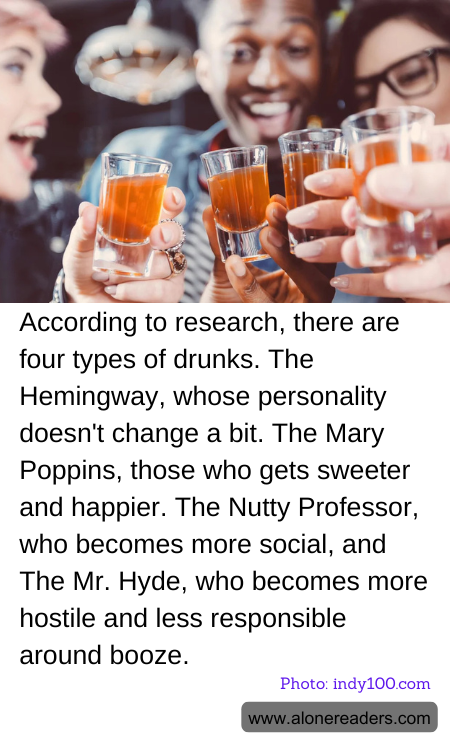
Alcohol has long been a lens through which we can see varying extensions of our personalities come to light. Intriguingly, research endeavors have managed to categorize these changes into four distinct types of drunks, naming them after well-known characters that encapsulate their essence. The first type, dubbed 'The Hemingway,' after the stoic, prolific writer Ernest Hemingway, describes individuals whose personalities see no notable shift due to intoxication. These people often remain as composed and coherent as they are when sober, making it sometimes hard to tell if they've had anything to drink at all.
Another type, called 'The Mary Poppins,' is named after the cheerful and caring nanny from P.L. Travers' beloved books. These individuals become notably sweeter and more congenial, exuding positivity and often becoming the joy of the gathering. Their increased happiness and amiable nature can significantly enhance the social experience of those around them.
On the contrary, 'The Nutty Professor,' inspired by the shy Dr. Jekyll-like character who transforms into the outgoing and charming Buddy Love, encompasses those who might typically be introverted but become significantly more social and extroverted under the influence of alcohol. This transformation can be quite dramatic, revealing a side of their personality that is usually subdued.
Lastly, there exists 'The Mr. Hyde' type, named after the sinister alter ego of Dr. Jekyll. This category comprises those who may exhibit more negative changes, becoming less responsible, more critical, or even aggressive as they drink. This transformation can often lead to unpleasant experiences both for the person and for those around them.
Understanding these categories can not only add a layer of humor when reflecting on one's own drinking behaviors and those of friends but also offers a useful frame of reference for predicting and managing the potential outcomes of alcohol consumption in various social settings. Although these categories do not encompass the full spectrum of individual differences and responses to alcohol, they provide an interesting perspective on the psychological effects of one of humanity's oldest social lubricants.
