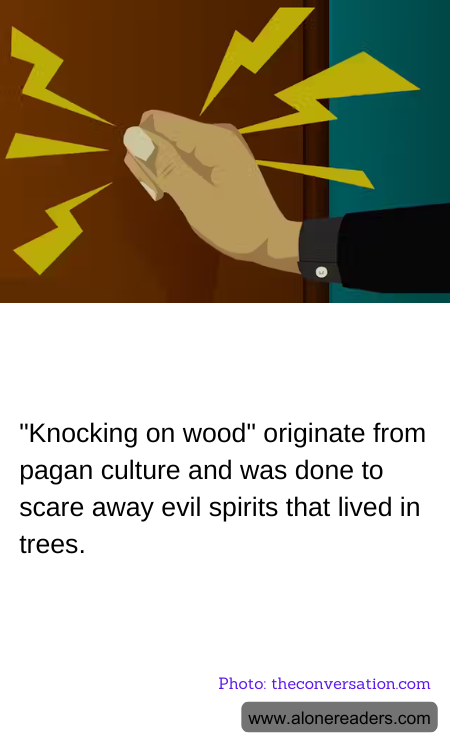
The act of knocking on wood, a superstition still observed today when someone wishes to avoid tempting fate after making a hopeful comment, has fascinating origins that trace back through various cultures and eras. This customary ritual, often performed by rapping one's knuckles on a piece of wood, is believed to originate from ancient pagan cultures, particularly those that flourished in Europe before the spread of Christianity.
In these early societies, trees were often held in high regard, considered sacred, and imbued with various spirits or deities. The veneration of trees can be seen in numerous mythologies and religions, where trees are symbols of life, growth, and fertility. Pagans, in particular, might have associated particular types of trees with different spiritual or mystical properties. For example, the oak tree was sacred to the Druids, and Norse mythology revered the ash tree Yggdrasil as the great tree that supported the heavens.
The act of knocking on wood was believed to call upon these tree spirits for protection or to ward off evil spirits. By knocking on the wood, individuals were essentially seeking the favor and good grace of the spirit residing within it, either to prevent disturbing them or to ask for their strength in ensuring that a stated hope or prediction did not turn to disappointment or disaster.
As this practice evolved and spread, the specific belief in tree spirits might have diminished, particularly with the spread of monotheistic religions in Europe which often suppressed pagan beliefs. However, the underlying gesture of seeking protection or good luck carried over and became normalized in different cultures irrespective of its pagan roots.
Though the exact route of transmission is not clear, "knocking on wood" has nonetheless become a widespread superstition across various cultures around the world, often simplified from its original religious or spiritual significance into a casual but earnest routine performed by individuals of all backgrounds. Whether its efficacy is believed genuinely or practiced half-heartedly, knocking on wood continues to be a charming, if curious, global testament to the human desire to influence fate and fortune.
