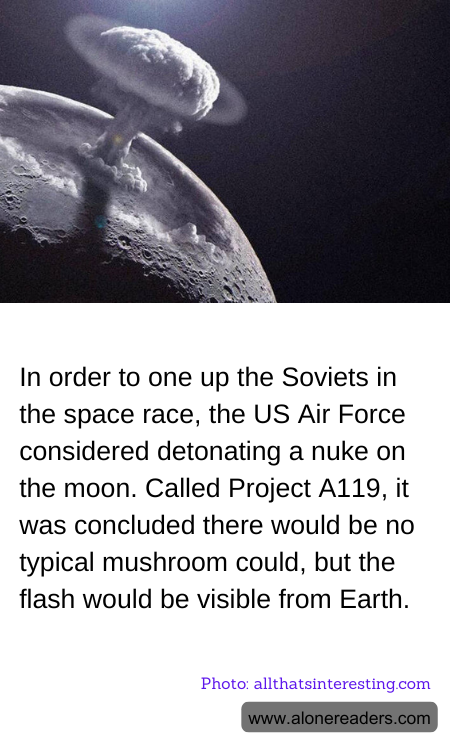
During the height of the Cold War, as the space race reached its fever pitch, the United States Air Force developed a top-secret plan that sounds like it's straight out of a science fiction novel. Known as Project A119, also referred to as "A Study of Lunar Research Flights," the objective was to detonate a nuclear bomb on the moon. The motivation behind this astonishing idea was to demonstrate overwhelming military and technological superiority to the Soviet Union, which had taken an early lead in the space race with the launch of Sputnik in 1957.
The idea was that by detonating a nuclear warhead on the moon, the United States could boost domestic morale and send a clear message of dominance to the Soviets and the rest of the world. Scientists involved in the project predicted that the explosion would not create the iconic mushroom cloud familiar on Earth due to the moon’s lack of atmosphere. Instead, the plan was for the nuclear explosion to produce a massive, visible flash of light—a dramatic spectacle that could be observed from Earth with the naked eye.
The project involved some of the era's foremost scientific minds, including astronomer Carl Sagan, who was then a young graduate student. Sagan's role involved calculating the behavior of the dust and gas that would be displaced by the explosion. It was essential for planners to understand not only the visibility of the explosion from Earth but also any potential scientific data that could be gleaned from the detonation.
Despite its ambitious goals, Project A119 was eventually shelved. Several factors contributed to its cancellation, including fears of a negative public reaction, concerns about contaminating the moon with radioactive debris, and the potential risks to future manned and unmanned missions to the moon. The project was declassified in 2000, revealing yet another layer of the complex and often audacious military strategies of the Cold War era.
In retrospect, the cancellation of Project A119 likely averted a serious escalation of nuclear arms demonstrations in space. This episode remains a fascinating footnote in the history of the space race—a reminder of the lengths to which nations were prepared to go to assert their dominance during one of the most tension-filled periods of the 20th century.
