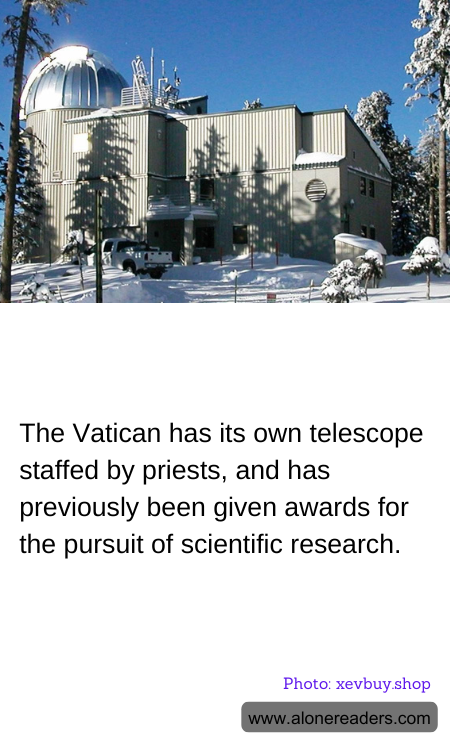
The Vatican's engagement with scientific inquiry, particularly in the field of astronomy, is a noteworthy chapter in the history of science. This unique intersection of faith and science is epitomized by the Vatican Observatory, one of the oldest astronomical research institutions in the world. Founded by Pope Gregory XIII in 1582, the observatory was initially established to assist in reforming the calendar and to provide a more accurate measure for the liturgical year. Over the centuries, this institution has evolved, embracing broader astronomical research, and today it stands as a significant symbol of the Church's pro-science stance.
Operated by the Jesuit order, the Vatican Observatory is staffed by priests who are also trained astrophysicists. These priest-scientists conduct cutting-edge astronomical research, contributing to the field through studies on galaxies, meteorites, and stars, among other subjects. The observatory's location has shifted over time due to the challenges posed by Rome's city lights. It is now primarily located at the Mount Graham International Observatory in Arizona, USA, where it operates the Vatican Advanced Technology Telescope (VATT). The VATT is esteemed for its advanced technology, including its optical system and its ability to provide clear, distinct images of the night sky, superior to those of traditional telescopes.
The Vatican has not only housed an observatory but has also recognized and honored scientific achievement more broadly, reflecting a harmonious relationship between faith and reason that the Catholic Church encourages. Historical moments, such as Pope John Paul II's 1992 declaration that the Church's denunciation of Galileo was an error, reinforce a modern stance that faith and science, rather than being at odds, can enlighten each other. This posture has enabled the Church to contribute positively to the dialogue between scientific and religious communities.
Moreover, the Vatican’s involvement in science and its observatory have achieved global recognition, earning accolades for bridging the gap between science and religion. Such endeavors debunk the myth that religion necessarily opposes scientific understanding and instead highlight a rich tradition of clerical scholars in the natural sciences. Vatican-sponsored conferences that bring together scientists and theologians to discuss issues from big bang theory to stem cell research further illustrate the Church's active participation in contemporary scientific discourse.
Therefore, the Vatican Observatory not only stands as a beacon of astronomical research but also as a testament to the enduring Catholic commitment to understanding the universe through the lens of both faith and reason. This dual approach seeks to offer a holistic understanding of human experience and the celestial phenomena that surrounds us.
