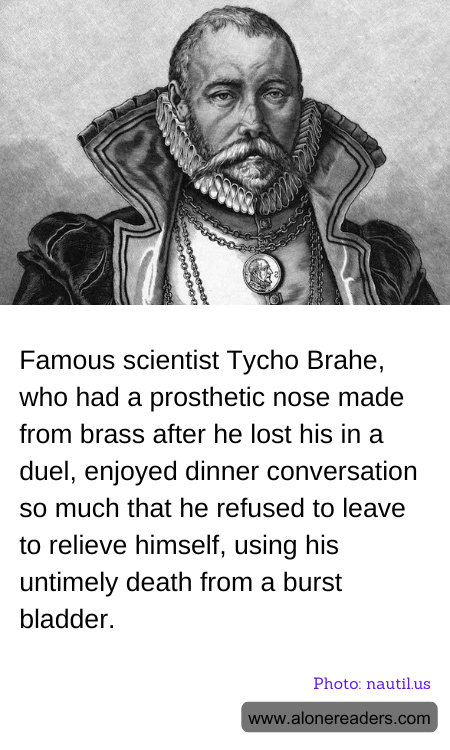
Tycho Brahe, one of the most colorful figures in the history of astronomy, was as famous for his peculiar lifestyle as he was for his substantial contributions to science. Born in 1546 in Denmark, Brahe was well known for his comprehensive astronomical and planetary observations. Perhaps one of the lesser-known but more curious aspects of his life involves the story of his prosthetic nose. In 1566, Brahe lost part of his nose in a duel with a fellow student over a mathematical formula. To mask his disfigurement, he wore a prosthetic nose reportedly made of brass, although some accounts suggest it might have been gold or silver.
Brahe's eccentricities extended beyond his artificial nose. He lived in a castle, maintained a private zoo, and kept a dwarf as a court jester who often sat under the dining table during meals. However, it is one of his habits at those very dining tables that is said to have led to his demise. Tycho reportedly enjoyed his dinner conversations so immensely that he would avoid excusing himself to use the restroom. According to historical accounts, this practice resulted in a fatal health issue.
One night in 1601, during a particularly long banquet, Brahe refused to leave the table to relieve himself, adhering to the etiquette of the time, which deemed it improper to leave before the meal was over. This decision proved disastrous, as he subsequently developed a severe bladder and kidney condition. It is said that he suffered from a burst bladder, though more modern medical assessments suggest he might have died from uremia or kidney failure due to urinary retention.
Brahe’s death highlights an intersection of cultural practices and personal health decisions within the context of 16th-century Europe. His contributions to astronomy, including the detailed astronomical observations that predated the telescope, helped lay foundations for future astronomers such as Johannes Kepler, who used Brahe’s data to formulate his planetary laws.
Thus, the life of Tycho Brahe serves not only as an epitome of remarkable scientific endeavor but also as a peculiar narrative interwoven with unique personal and historical quirks, reflecting the rich tapestry of the scientific renaissance period.
