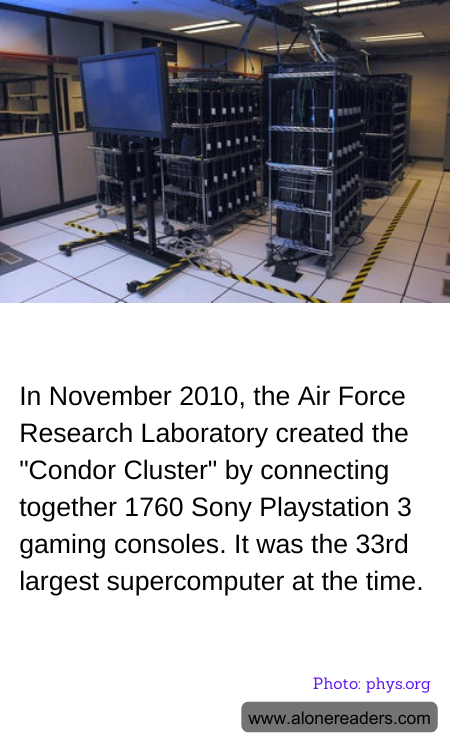
In a surprising fusion of consumer technology and military computing power, November 2010 witnessed the birth of the "Condor Cluster," a formidable supercomputer made by the Air Force Research Laboratory (AFRL). This innovative project repurposed 1,760 Sony PlayStation 3 (PS3) consoles, transforming them from gaming platforms to a powerhouse in high-performance computing. The PS3's inclusion in this unique arrangement was primarily due to its powerful Cell processor, which offers substantial parallel processing capabilities—a key feature for complex computations in a supercomputing environment.
By utilizing the PS3, the AFRL managed to create a cost-effective yet powerful computational tool. The total cost was a fraction of what traditional supercomputers might require, largely because the PS3 was already a mass-produced consumer product, which kept the price per unit low. Furthermore, the energy efficiency of the PS3 units made the Condor Cluster one of the most eco-friendly supercomputers of its time. The ability to run on approximately 10% of the power required by comparable supercomputing systems represented not only a significant saving in ongoing operational costs but also aligned with broader environmental goals.
The primary use of the Condor Cluster was to analyze high-definition satellite imagery and process extensive radar data, tasks that are crucial for national security and require substantial computational strength. The cluster's impressive capabilities also lent themselves to research in artificial intelligence and machine learning, areas that are increasingly relevant to modern military applications.
Despite being ranked as the 33rd largest supercomputer at its inception, the Condor Cluster's unique composition drew significant attention beyond its size. It demonstrated a pioneering example of how off-the-shelf technology could be repurposed in innovative ways to not only save costs but also to reduce the carbon footprint associated with high-scale computations.
This project underscored a significant moment in the evolution of supercomputing, illustrating how creative solutions can successfully meet the intricate needs of scientific research and national security without the need for exorbitant resources or traditional approaches. The legacy of the Condor Cluster remains a testament to the unexpected versatility of consumer electronics when applied to the challenges of high-performance computing.
