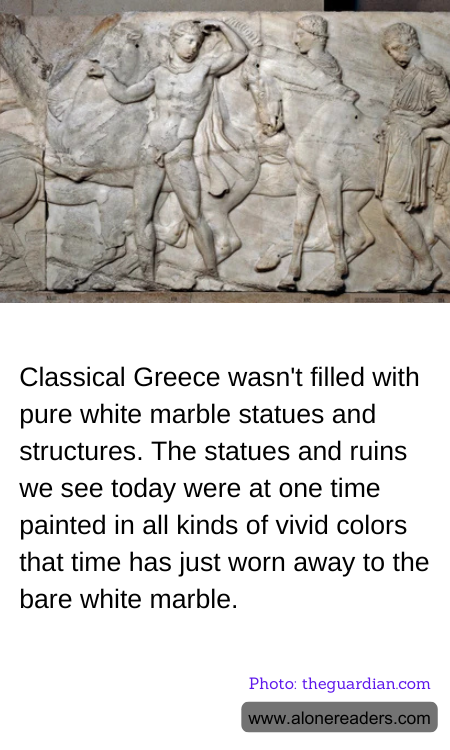
The classical world of ancient Greece is often misrepresented in modern imaginations as a realm of pristine white marble statues and gleaming, untouched architecture. In reality, the ancient Greeks embraced a vivid palette of colors in their artistic expressions. The statues and buildings that now appear as uniform white marble were originally adorned in hues of blue, red, green, and gold, among others. Over the centuries, natural weathering processes and human intervention softened these bright colors into the monochromatic tones we see today.
This misconception stems partly from early archeological discoveries that unearthed primarily bleached statues and structures, stripped of their colorful finishes by time. Initial excavators and scholars of the 18th and 19th centuries often prized the classical beauty of white marble, aligning it with their own ideals of purity and perfection, which reinforced the misperception of an all-white ancient Greek aesthetic.
It wasn't until the advent of more sophisticated scientific methods and technology, such as ultraviolet light and pigment residue analysis, that historians and archaeologists were able to provide evidentiary backing to the claims of classical polychromy (the practice of decorating sculptures or architectures in a variety of colors). This evidence shows that the ancient Greeks painted their sculptures in vibrant colors to enhance realism or to convey symbolic or narrative details. For example, strategic use of color could highlight anatomical details, enhance the visibility of statues from afar or convey coded messages or attributes, like red for skin tones and blue or green for the eyes.
The truth about the colorful past of Greek statuary and architecture allows modern observers to appreciate these artifacts within a more accurate historical context. Public and scholarly perception has shifted, understanding now that the stark white marbles were once exhibitions of bold colors and dramatic artistic expression. This insight provides a fuller, richer comprehension of ancient Greek culture and artistry that transcends the simplicity of colorless marble. The reimagined view of their polychromatic past revitalizes our connection to the ancients, painting their world as vividly and dynamically as they themselves possibly viewed it.
