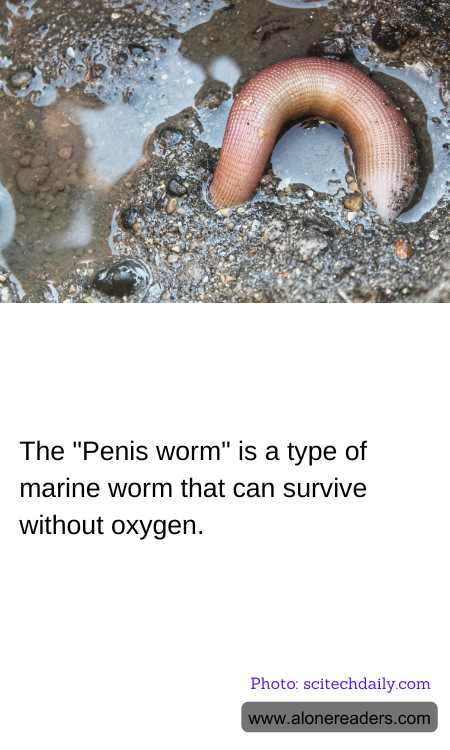
The "penis worm," officially known as Priapulida, is a fascinating marine creature known for its striking resemblance to the human penis, which accounts for its provocative moniker. These worms are intriguing not just because of their unique appearance, but also because of their extraordinary ability to survive in harsh, oxygen-depleted environments.
Priapulida are found in various parts of the world's oceans, from shallow waters to the deep sea. They burrow into the sea floor, consuming organic matter and small animals as part of their diet. Their resilience is particularly notable because they dwell in environments like the anoxic zones—areas completely devoid of oxygen that exist in many deep-sea habitats. Remarkably, these creatures can endure these extreme conditions, showcasing a remarkable level of adaptation.
The ability of penis worms to survive without oxygen hints at their ancient evolutionary origins. Scientists believe that Priapulida emerged around 500 million years ago, during the Cambrian period. This era was known for its "Cambrian Explosion," a time of rapid evolutionary development when most major animal groups first appeared in the fossil record. Priapulida's survival skills may have been crucial during periods of Earth's history when oxygen levels were much lower than today.
Research into the penis worm's survival mechanisms in low-oxygen environments could provide insights into how life could sustain itself in other similarly harsh locales, like the subsurface oceans of icy moons in our solar system such as Europa or Enceladus. Studies involving these worms could also deepen our understanding of evolutionary biology, giving us clues about the adaptability and resilience of life forms in Earth's early environments.
Moreover, their physiological adaptations might also inform biotechnology and biomedical research, providing models for developing life support systems or engineering solutions that enable survival in low-oxygen conditions. Thus, while their name might initially draw curiosity or amusement, the penis worms stand as a testament to the complexity and endurance of life, extending our knowledge of biology and potentially aiding in the development of technologies for extreme environments.
