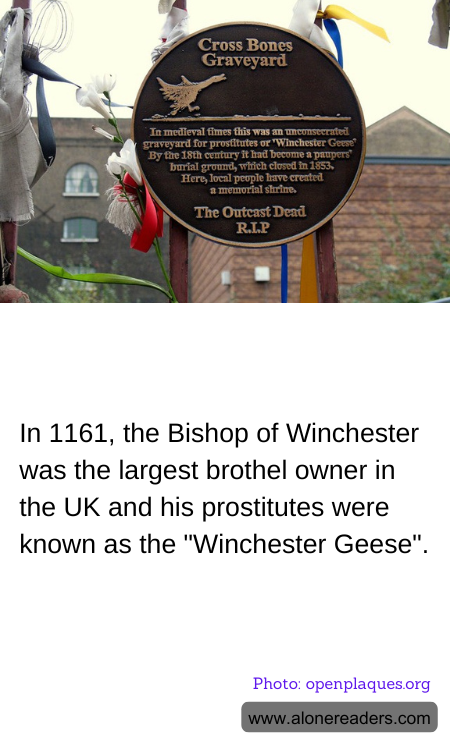
In the medieval period, the connection between the church and various secular businesses could often be surprising by modern standards. One of the most striking examples of this was in 1161, when the Bishop of Winchester, who was not only a religious leader but also a significant secular authority, became influential in a less sanctimonious field: he was effectively the largest brothel owner in the United Kingdom. The brothels under his control were strategically located in the Southwark district of London, which, due to its positioning outside the main city and beyond the reach of the City of London's jurisdiction, had become a hub for entertainment and vice.
The Bishop did not operate these establishments directly, but rather leased out land and provided licenses to brothel keepers under his authority, in return for payments. This arrangement made him a significant figure in the profitable business of prostitution. The women working in these brothels were colloquially known as the "Winchester Geese," a darkly humorous moniker referring to their association with the Bishop of Winchester.
This term was not affectionate; it was more of a stark reminder of the limited rights and harsh realities faced by these women. The nickname reflected both their plight and their patronage by one of the highest institutions of the land, underscoring the profound contradictions within the Church at the time. These women, while providing financial benefits to a high-ranking church official, were not afforded protection or dignity. Upon their deaths, many were denied a Christian burial because of their profession and were often buried in unmarked graves on unconsecrated ground, such as the "Cross Bones" graveyard in Southwark, which was reserved for "single women," a euphemism at the time for prostitutes.
The existence of the "Winchester Geese" and their association with a leading religious figure underlines the complex social and economic landscapes of medieval England. It serves as a reminder of how religious and secular powers could intermingle and highlights the often contradictory roles played by religious leaders, who could both condemn sin and simultaneously profit from it. The story of the Winchester Geese is just one facet of the larger narrative of how moral and economic considerations could interact in unexpected ways, creating peculiar historical realities that resonate through to modern times.
