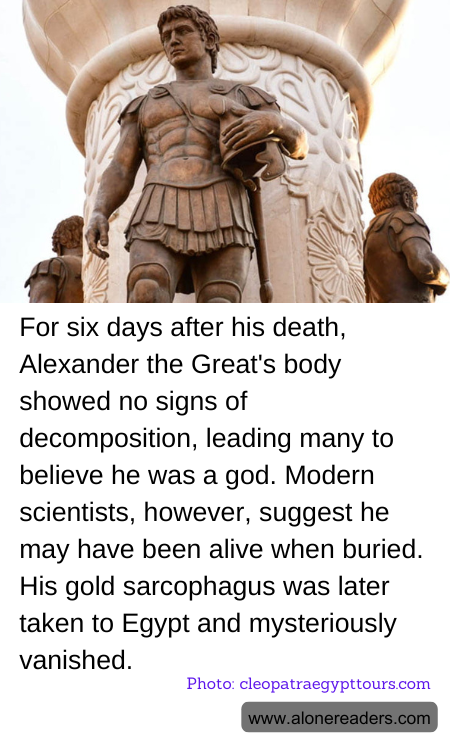
Alexander the Great, one of history's most legendary conquerors, continues to fascinate not only for his monumental achievements in expanding the Hellenistic world but also for the mysteries surrounding his death in 323 BC. Remarkably, accounts from ancient historians tell us that Alexander's body did not show any signs of decomposition for six days following his death, a phenomenon that contributed to the belief among his followers that he was divine. In ancient cultures, such miraculous preservation was often regarded as a sign of godliness, supporting the deification of Alexander in the years following his demise.
Modern scientific perspectives suggest a more earthly explanation for this lack of decay, raising the chilling possibility that Alexander was not actually dead, but in a state of profound paralysis or coma. Medical experts speculate that Alexander might have suffered from Guillain-Barré Syndrome or another condition that could mimic death, slowing his metabolism and delaying decomposition. This theory implies that Alexander the Great could have been buried alive, an idea that casts a dark shadow over the initial stages of his journey to eternal rest.
After his death, Alexander's remains became a symbol of legitimacy and power. Ptolemy I, one of Alexander’s former generals and the new ruler of Egypt, seized his body as it was being transported back to Macedon, redirecting it to Memphis, Egypt, and later moving it to Alexandria. Alexander was initially laid in a magnificent gold sarcophagus, which was placed in a mausoleum that became a famous center of Hellenistic pilgrimage. However, over the centuries, the exact whereabouts of Alexander’s tomb and the golden sarcophagus have become lost to time. Despite extensive archaeological efforts, both remain coveted and elusive treasures. Their disappearance is shrouded in mystery, fueling a range of theories about the possible plundering and subsequent hidden resting place of one of history’s greatest rulers.
The story of Alexander’s death and the subsequent odyssey of his body encapsulates the blend of hero worship, intrigue, and mystery that often surrounds legendary figures. It also highlights our ongoing fascination with the interplay between historical facts and myth, and how each new interpretation can shift our understanding of the past.
