More About This Card
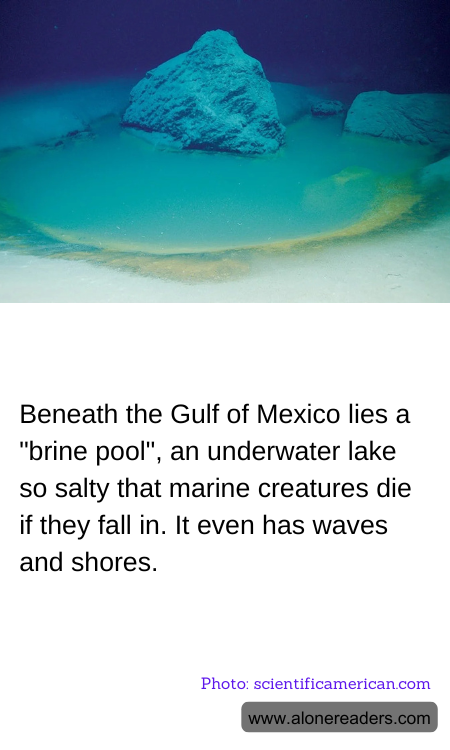
In the mysterious depths of the Gulf of Mexico, there exists a surreal natural phenomenon known as a "brine pool." This underwater feature, resembling a lake or a sea within the sea, is characterized by its extreme salinity. This salinity is so high that it creates a dense body of water that does not mix with the surrounding ocean. This results in a distinct and eerie landscape underwater, complete with an appearance of waves and shores much like a terrestrial lake.
Brine pools are formed from salt tectonics, a process related to the movement and deformation of salt deposits buried deep beneath the sea bed. These pools are essentially areas where salt has dissolved in water to create a saline solution that is much heavier than the rest of the sea water. This difference in density causes the brine to settle at the lowest available point, forming a pool.
The environment within these pools is hostile to most marine life due to the toxic levels of salinity and the lack of oxygen. The water in brine pools is often saturated with methane and hydrogen sulfide, making it inhospitable for most organisms. Creatures that mistakenly wander into these brine pools often do not survive, leading to the eerie sight of preserved dead bodies around these underwater lakes, earning them the nickname "jacuzzis of despair."
Nevertheless, these hostile environments host unique forms of life adapted to extreme conditions. Specialized bacteria and other extremophiles thrive at the edges of these pools, supporting complex ecosystems. These organisms are often of significant interest to scientists as they can provide insights into the limits of life on Earth and possibly on other celestial bodies.
The brine pools also offer valuable clues to geologists and oceanographers about the Earth's geologic past and the dynamics of seabed processes. These studies can lead to better understanding of natural seafloor methane release and its implications for global climates.
Moreover, the eerie and otherworldly beauty of brine pools continues to attract the attention of deep-sea explorers and researchers, equipped with advanced submersibles and remotely operated vehicles, who endeavor to study and document these fascinating underwater features. Each expedition brings to light new details and raises awareness about these lesser-known corners of Earth's natural environment, highlighting the diversity and resilience of life forms and the ongoing dynamics of our planet’s marine landscapes.