More About This Card
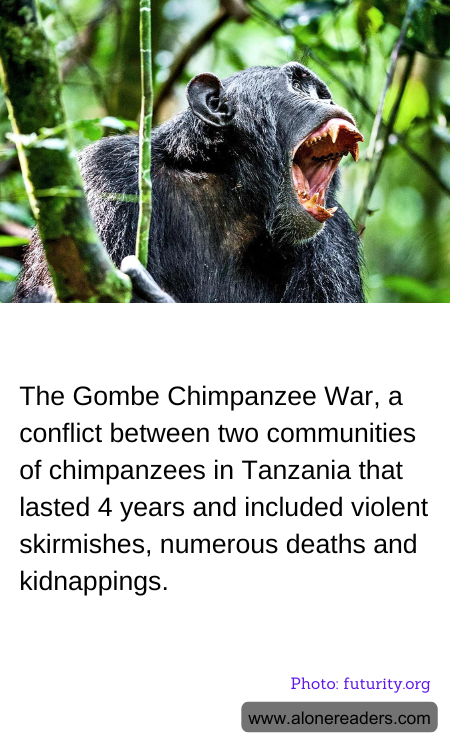
The Gombe Chimpanzee War, also known as the Gombe Stream Research Centre, represents a significant episode in the study of animal behavior, particularly that of chimpanzees, which are our closest living relatives. The conflict took place in Gombe National Park, Tanzania, and lasted from 1974 to 1978, marking the first recorded instance of a war among non-human animals.
The war erupted following a split in a community of chimpanzees that was closely observed by the famed primatologist Jane Goodall. The community fractured into two factions: the Kasakela and the Kahama. The Kasakela group inhabited the northern territory of the original community's range, while the smaller Kahama faction occupied the southern portion. This division appears to have been partly influenced by the increase in population and competition for resources, alongside complex social tensions.
The conflict involved aggressive and often lethal raids, where members of the Kasakela group would systematically launch surprise attacks on solitary members of the Kahama group. Over the course of the four-year war, all six adult males of the Kahama faction were killed, along with at least one female, and several females were kidnapped and assimilated into the Kasakela group. The violence was shocking to researchers, as it included cannibalism and brutal killings, challenging previous notions of chimpanzee behavior as inherently passive or benign.
The implications of the Gombe Chimpanzee War shed light on the evolutionary roots of human warfare and social conflict. The observations by Goodall and her team raised profound questions about the nature of aggression in primates, suggesting that war and territoriality are not solely human traits but can occur in other species under certain ecological and social conditions. This has further fueled discussions in anthropological circles about the roots of violence and group identity in humans.
By the war's end, the Kasakela emerged as the dominant faction, having expanded their territory significantly. The aftermath allowed the researchers to study how territorial gains affected the victors' food availability, mating opportunities, and overall health. These events have continued to inform studies of primate behavior, contributing to our understanding of the complexities of animal societies and deepening the comparative analyses of human and non-human conflict and cooperation.