More About This Card
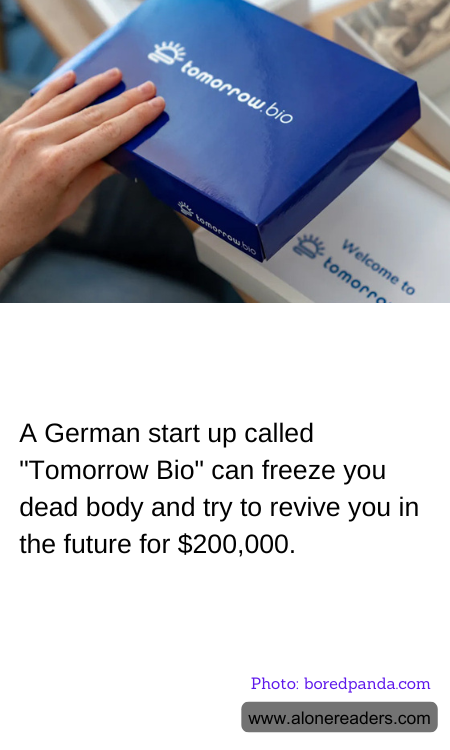
A German startup, Tomorrow Bio, offers a service that sounds like something out of a science fiction novel: they can freeze your dead body with the promise of attempting to revive you in the future. The service costs $200,000, a price that includes the process of cryopreservation, which is the use of very low temperatures to preserve human bodies, in the hope that technological advancements will eventually make it possible to bring them back to life.
Cryopreservation has been a topic of interest and controversy in the scientific and ethical realms for decades. The basic premise is to preserve the body immediately after death to prevent decay and protect the physical structure of cells and tissues. Then, theoretically, future medical and technological breakthroughs could potentially revive the person and cure whatever led to their death, whether it be a disease or old age.
Critics of cryonics argue that the science behind it is not yet reliable or proven, and ethical questions about the quality of life upon revival, the impact on population growth, and the emotional implications for revived individuals and their families remain largely unresolved. Yet, despite these uncertainties, there is a growing community of people who are opting for cryopreservation, motivated by a combination of fear of death, hope for a second chance at life, and faith in future technology.
Tomorrow Bio operates under stringent regulations to ensure that the whole process is conducted legally and ethically. They follow meticulous protocols starting from the moment of the client's death, which involves immediate cooling and treatment with chemicals aimed at protecting tissues and cells from ice damage. This is followed by storage in liquid nitrogen tanks at temperatures below -196 degrees Celsius.
While the concept of cryonics continues to challenge our contemporary understanding of life and death, it has undeniably opened a new frontier in the field of life extension technologies. Proponents see it as a stepping stone to a future where death could be more of an inconvenience than an absolute, and they regard the high cost as an investment in potential future life.
As the technology evolves and societal attitudes shift, the practice could become more mainstream, or it could remain a niche choice for those with the means and the desire to gamble on future scientific breakthroughs. For now, companies like Tomorrow Bio are paving the way for these possibilities, offering services that, while controversial, ignite the imagination about what might be achievable in the decades or centuries to come.