More About This Card
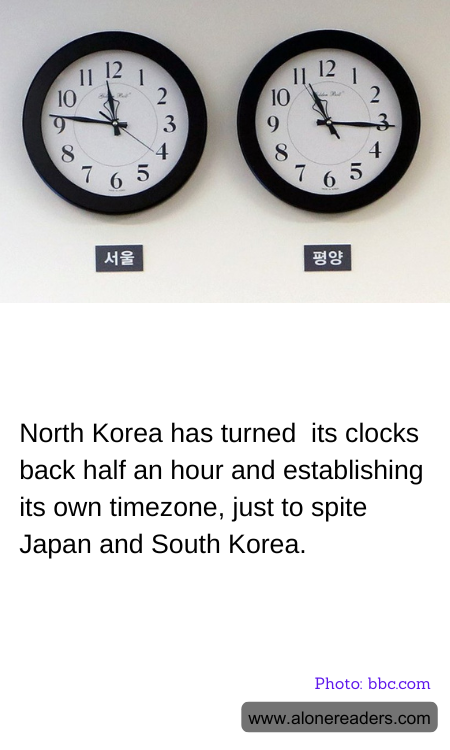
In a move that was both symbolic and assertive, North Korea adjusted its clocks back by 30 minutes, establishing what it calls "Pyongyang Time." This decision, announced in 2015, uniquely positions North Korea in a time zone different from both South Korea and Japan. This change was not merely about altering time; it was deeply rooted in historical grievances and a desire to assert a distinct national identity.
The shift back to GMT+8:30 was described by North Korea as a rejection of imperialism. The original change to align with Japanese time had been imposed in 1912 during Japan's colonial rule over the Korean peninsula, a period that lasted until the end of World War II in 1945. By reverting to the pre-colonial time setting, North Korea aimed to symbolically cleanse itself of the past impositions and underscore its sovereignty.
This decision was reflective of the broader, complex relationship between North Korea, South Korea, and Japan. The timing issue might seem trivial at first glance, but it carries deeper implications about regional politics and the assertion of power. Time zones, in this context, become more than just a way to standardize time; they serve as a statement of national independence and cultural heritage.
Internationally, the move was met with a mixture of curiosity and criticism. Adjusting a time zone, especially by 30 minutes, is relatively uncommon and can complicate diplomatic meetings, international travel, business operations, and broadcasting schedules. For South Korea and Japan, the shift was another instance of North Korea distancing itself from regional cooperation and norms.
Yet, the decision also had internal implications within North Korea, reflecting the regime’s ongoing efforts to delineate its unique path apart from global influences. By establishing "Pyongyang Time," North Korea not only revived a link to its pre-colonial past but also reinforced the regime's control over daily aspects of life, embedding the government’s influence into the very fabric of how time is measured and lived by its citizens. The act of setting one's own time zone transcends the pragmatic aspects of clock settings, resonating deeply with nationalistic sentiments and the ongoing narrative of defiance against foreign dominance, most notably from Japan and, by extension, the Western world.