More About This Card
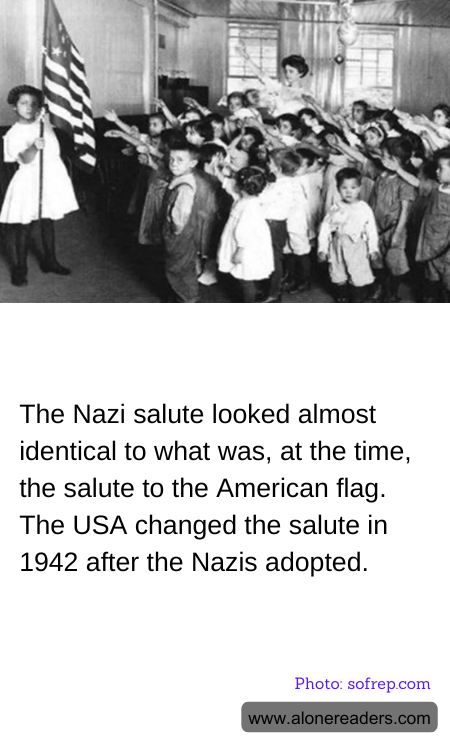
The similarity between the Nazi salute and the salute once used in the United States for the Pledge of Allegiance is a little-known and often surprising historical fact. Prior to the 1940s, the salute accompanying the Pledge of Allegiance involved extending the right arm toward the flag with the palm down, in a gesture called the Bellamy salute, named after Francis Bellamy who created the Pledge of Allegiance in 1892. This gesture bore an unsettling resemblance to the salute used by the Nazis, known as the Hitler salute, where individuals would extend their right arm forward and slightly raise, usually accompanied by the phrase "Heil Hitler."
As Adolph Hitler rose to power in Germany in the 1930s, and the atrocities of the Nazi regime became increasingly apparent, the similarity between the American and German salutes started to cause discomfort in the United States. The use of the Bellamy salute began to be seen as inappropriate and politically unsavory due to its visual similarity to the Nazi gesture, which was becoming a symbol of oppression and horror.
In response to growing unease and the undesirable association with Nazi Germany, Congress amended the Flag Code on December 22, 1942, during the height of World War II. This change was led by efforts to clearly delineate American patriotism from fascist ideologies. The amendment instructed that the Pledge of Allegiance be recited with the right hand placed over the heart, a gesture that symbolized loyalty and love for the country, rather than the previous impersonal and now politically charged gesture of the Bellamy salute.
This shift was not just a change in protocol, but also a profound statement of values and identity. By altering the salute, the United States sought to reaffirm its foundational principles of democracy and freedom, starkly contrasting the tyrannical and autocratic ideologies represented by the Nazi salute. The change in the salute to the flag thus serves as an historic example of how symbols and rituals adapt in response to global events and political meanings, reflecting deep national values and evolving political landscapes.