More About This Card
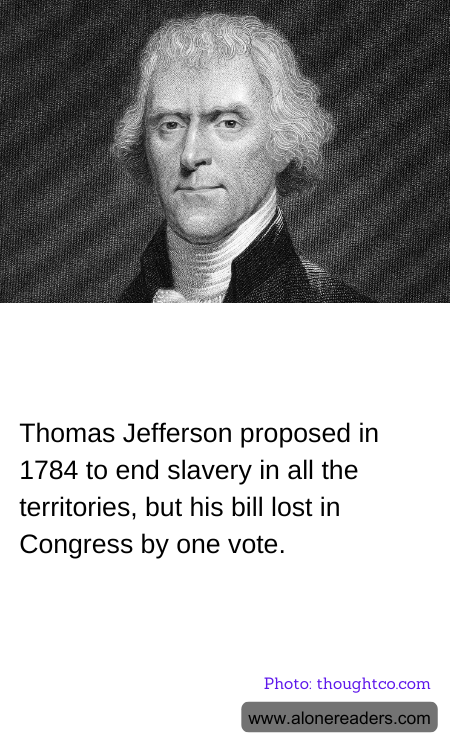
Thomas Jefferson, the third President of the United States and a complex figure in the history of American slavery, made a notable legislative attempt to halt the spread of slavery during the nation's early expansion. In 1784, Jefferson drafted the "Jefferson Ordinance of 1784" which proposed banning slavery in new territories after 1800. This ordinance, if passed, would have applied to all territories of the United States that were not yet states, effectively limiting the expansion of slavery in the westward territories.
Jefferson's proposal was motivated by his ambiguous views on slavery. He owned slaves himself yet publicly expressed a desire to end the institution, which he believed was morally and politically harmful to the republic. His ordinance aimed to prevent the creation of new slave states beyond the original thirteen colonies. The bill was a precursor to later measures like the Northwest Ordinance of 1787, which banned slavery in the Northwest Territory, though it notably allowed states south of the Ohio River to decide on slavery for themselves.
The vote on Jefferson's anti-slavery clause was a narrow defeat, falling short by just one vote in the Confederation Congress. Some historical accounts suggest that the missing vote was due to a representative from New Jersey who was ill and could not attend, which if present, could have changed the outcome. This defeat meant that slavery was allowed to take root in what would become some of the new states west of the original colonies.
Had Jefferson’s proposal succeeded, it might have significantly altered the pattern of American history, possibly preventing the spread of slavery into new areas and reducing the probability of conflict like the Civil War. The failure of the bill highlighted the deep divisions on the issue of slavery that would only intensify as the nation expanded. This incident stands as a poignant reminder of how a single vote can influence the course of history in profound and lasting ways.