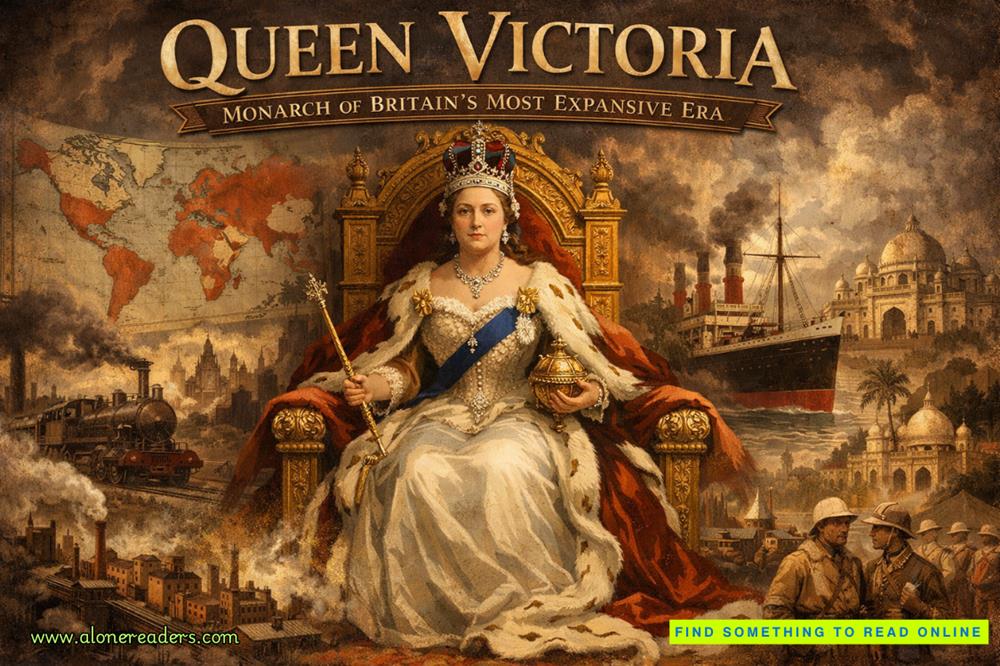
Queen Victoria ascended the British throne in 1837 as an eighteen-year-old woman with limited political preparation, little worldly experience, and modest expectations placed upon her by Europe’s entrenched male-dominated power structures. Yet over the course of her reign, she would become one of the most influential female sovereigns in recorded history, presiding over a period of unprecedented territorial expansion, industrial acceleration, cultural consolidation, and imperial self-confidence. Her era would eventually bear her name, not merely as a chronological marker, but as a symbol of an age defined by discipline, hierarchy, moral certainty, and imperial ambition.
At the time of her accession, Britain was already a constitutional monarchy, but the precise balance between crown, parliament, and public opinion remained fluid. Victoria inherited a state grappling with the social consequences of industrialization, the lingering instability of post-Napoleonic Europe, and the pressures of governing an expanding overseas empire. What distinguished her reign was not direct legislative authority, but the sustained exercise of influence, achieved through personal relationships with ministers, careful cultivation of public image, and an unwavering belief in the sanctity of monarchy as a moral institution.
Victoria’s early years on the throne were marked by vulnerability and intense scrutiny. Raised under the restrictive “Kensington System,” she had been deliberately sheltered from political autonomy, a fact that paradoxically strengthened her resolve once crowned. Her correspondence from this period reveals a young queen determined to assert independence, insisting on choosing her own household, advisors, and routines. This assertion of personal sovereignty laid the foundation for a reign in which the monarch would wield soft power with remarkable effectiveness, shaping policy indirectly while maintaining constitutional propriety.
Her marriage to Prince Albert of Saxe-Coburg and Gotha in 1840 fundamentally transformed both her personal life and her style of governance. Albert emerged as a critical intellectual and administrative partner, advising on foreign affairs, scientific advancement, education reform, and industrial policy. Together, they redefined the monarchy as a model of domestic virtue, discipline, and bourgeois respectability, aligning royal identity with the values of Britain’s expanding middle class. This recalibration was politically astute, reinforcing popular support for the crown at a time when European monarchies were increasingly vulnerable to revolution.
The Victorian era coincided with the most dramatic territorial expansion of the British Empire, extending its reach across Africa, South Asia, the Middle East, and the Pacific. While Victoria did not personally direct colonial conquest, she actively embraced the imperial mission as both a civilizing endeavor and a divine responsibility. Her adoption of the title Empress of India in 1876 was not ceremonial excess, but a calculated assertion of imperial unity, intended to bind colonial subjects to the crown through symbolism and hierarchy. It signaled a transition from mercantile empire to explicit imperial sovereignty, with the monarch positioned as the ultimate source of authority.
Domestically, Victoria’s reign unfolded alongside sweeping social change. Industrialization reshaped cities, labor relations, and class structures, producing both immense wealth and profound inequality. Although often portrayed as socially conservative, Victoria was not indifferent to reform. She supported measures that improved working conditions, expanded education, and professionalized public administration, provided they preserved social order. Her outlook reflected a belief in gradual progress anchored by moral responsibility, rather than radical transformation driven by popular agitation.
The queen’s influence over her prime ministers was substantial, particularly in matters of foreign policy and imperial administration. Her long relationships with figures such as Lord Melbourne, Benjamin Disraeli, and William Gladstone reveal a monarch deeply engaged with statecraft. She read government papers meticulously, wrote extensive marginal notes, and maintained a voluminous correspondence that functioned as a parallel channel of political consultation. While she respected parliamentary supremacy, she expected to be informed, consulted, and heeded—a standard that shaped the modern conventions of constitutional monarchy.
Personal tragedy profoundly altered Victoria’s public role. The death of Prince Albert in 1861 plunged her into prolonged mourning and temporary withdrawal from public life. This retreat triggered criticism and republican sentiment, yet it also humanized her in the eyes of the public. Over time, her grief became integrated into her image as a suffering yet steadfast matriarch of the nation, reinforcing emotional loyalty to the crown. Her eventual reemergence, marked by jubilees celebrating decades of rule, transformed her into a living symbol of continuity amid accelerating change.
Culturally, the Victorian era was defined by contradictions that mirrored the queen herself. It was an age of moral rigidity and private excess, scientific rationalism and religious fervor, confidence in progress and anxiety about degeneration. Victoria’s personal values—duty, restraint, family loyalty—were projected onto the nation as aspirational norms. Through patronage, ceremony, and symbolism, the monarchy became a stabilizing force that anchored national identity during a period of relentless transformation.
By the time of her death in 1901, Queen Victoria had reigned for over sixty-three years, longer than any British monarch before her. Britain stood at the height of its imperial power, commanding vast resources, global trade networks, and unrivaled naval supremacy. Yet beneath this dominance lay the seeds of future strain: nationalist movements in the colonies, labor unrest at home, and geopolitical rivalries abroad. Victoria did not merely witness these dynamics; she embodied the authority that sustained them, providing legitimacy to an empire whose coherence depended as much on symbolism as on force.
Queen Victoria’s historical significance lies not in legislative innovation or battlefield command, but in her mastery of endurance, representation, and influence. She transformed monarchy from a vulnerable institution into a central pillar of national and imperial identity, adapting ancient authority to the realities of a modernizing world. As a woman ruling in an era that constrained female power, she reshaped expectations not through overt rebellion, but through sustained presence, strategic engagement, and unwavering conviction. Her reign remains a defining chapter in global history, illustrating how personal character, institutional adaptation, and historical circumstance can converge to produce enduring power.





 The Hundred Days Offensive: How the Allies Defeated Germany in World War I
 The Second Battle of the Marne: The Turning Point of World War I in 1918
 The Spring Offensive of 1918: Germany's Final Gamble to Win World War I
 The Treaty of Brest-Litovsk: How Russia Left World War I
 The Russian Revolution and World War I: How War Brought Down the Tsar
 The Zimmermann Telegram Explained: Germany's Secret Offer to Mexico in World War I