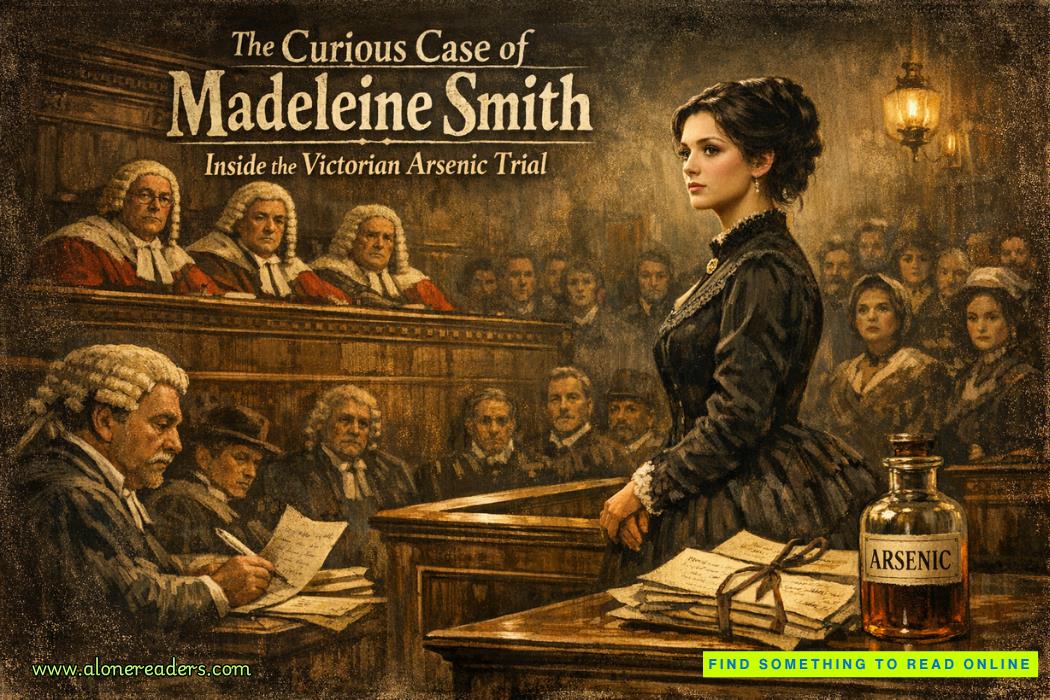
The story of Madeleine Smith remains one of the most enigmatic criminal cases of the Victorian era—a scandal that fused romance, class tension, and forensic intrigue into a trial that captivated Britain in 1857. At its core lay a simple yet devastating question: did a young, respectable woman poison her lover with arsenic, or was she the victim of circumstantial suspicion amplified by rigid societal expectations? The answer, even after the verdict was delivered, remained elusive, cementing the case as one of the most debated in legal history.
Madeleine Smith was born into a prosperous middle-class family in Glasgow, Scotland. Her father was a well-established architect, and the family’s social standing placed Madeleine firmly within the expectations of Victorian respectability. Young women of her class were expected to be virtuous, obedient, and above all, careful in matters of romance. Yet beneath this veneer of propriety, Madeleine led a secret life that would ultimately unravel with tragic consequences.
The central figure in this hidden narrative was Pierre Émile L’Angelier, a clerk of French origin. Their relationship began innocently enough, but quickly evolved into a passionate and clandestine affair. The secrecy was not merely a matter of discretion; it was essential. L’Angelier was not considered a suitable match for a woman of Madeleine’s status, and the social consequences of such a liaison could be devastating. Their correspondence—hundreds of letters exchanged over time—revealed a relationship marked by intense emotion, possessiveness, and mounting tension.
As the affair progressed, Madeleine’s circumstances changed. Her family began arranging a more socially appropriate marriage for her, placing her in a precarious position. She sought to distance herself from L’Angelier, but he refused to release his hold. His letters became increasingly desperate and threatening, suggesting that he might expose their relationship. In the rigid moral climate of Victorian society, such exposure would have been catastrophic for Madeleine’s reputation and future.
It was against this backdrop that arsenic entered the story. Madeleine had purchased arsenic on multiple occasions, ostensibly for household purposes such as killing vermin. At the time, arsenic was widely available and commonly used, making its acquisition neither unusual nor immediately suspicious. However, the frequency and timing of her purchases would later become a critical element in the prosecution’s case.
In March 1857, L’Angelier fell violently ill after consuming cocoa believed to have been prepared by Madeleine. He recovered temporarily, only to suffer a second, more severe episode days later. This time, the illness proved fatal. Medical examination revealed symptoms consistent with arsenic poisoning, and subsequent analysis confirmed the presence of the toxin in his body. Suspicion quickly turned toward Madeleine.
The investigation uncovered the extensive correspondence between the two, providing a window into their relationship. The letters were intimate, revealing not only the depth of their involvement but also Madeleine’s increasing desire to extricate herself. To Victorian sensibilities, the content of these letters was scandalous, and their public disclosure during the trial would have a profound impact on how Madeleine was perceived.
The trial itself became a spectacle, drawing widespread public attention. It was not merely a legal proceeding but a social drama that touched on issues of morality, gender, and class. Madeleine Smith stood accused of murder, yet her demeanor and appearance—composed, elegant, and outwardly respectable—complicated the narrative. Could such a woman be capable of calculated poisoning?
The prosecution’s case rested heavily on circumstantial evidence. They argued that Madeleine had both motive and means. The motive was clear: she wished to rid herself of L’Angelier to secure her future marriage and protect her reputation. The means were equally apparent in her repeated purchases of arsenic. The prosecution also pointed to the timing of these purchases in relation to L’Angelier’s illness, suggesting deliberate intent.
However, the defense mounted a formidable counterargument. They emphasized the lack of direct evidence linking Madeleine to the administration of poison. While arsenic was found in L’Angelier’s body, there was no definitive proof that Madeleine had given it to him. The defense also questioned the reliability of the forensic evidence, which, by modern standards, was still in its infancy. Chemical analysis techniques of the time, though advanced for their era, were not infallible.
A key element of the defense strategy was to cast doubt on L’Angelier’s own actions. They suggested that he might have ingested arsenic himself, either accidentally or intentionally. This theory, while speculative, introduced enough uncertainty to challenge the prosecution’s narrative. Additionally, the defense sought to humanize Madeleine, portraying her as a young woman caught in a difficult and emotionally charged situation rather than a cold-blooded killer.
The role of societal expectations cannot be overstated in understanding the dynamics of the trial. Victorian ideals of femininity played a subtle yet significant role in shaping perceptions. The image of Madeleine as a respectable young lady worked both for and against her. On one hand, it made the accusation of murder seem incongruous; on the other, the revelation of her secret affair painted her as morally compromised in the eyes of many.
Perhaps the most intriguing aspect of the trial was the verdict itself. After deliberation, the jury returned a verdict of “not proven”—a unique feature of the Scottish legal system. This verdict did not equate to a declaration of innocence; rather, it indicated that the prosecution had failed to establish guilt beyond reasonable doubt. It was a middle ground, leaving the question of Madeleine’s culpability unresolved.
The “not proven” verdict has often been described as both a shield and a shadow. For Madeleine, it meant she avoided conviction and the severe penalties that would have followed. Yet it also ensured that suspicion would linger indefinitely. She was neither acquitted nor condemned, existing in a state of legal ambiguity that has fueled debate for generations.
Following the trial, Madeleine Smith withdrew from public life. She eventually left Scotland, reportedly emigrating and living under a different name. The details of her later years remain sparse, adding another layer of mystery to her story. Unlike many historical figures whose lives are well documented, Madeleine seemed to vanish from the historical record, leaving behind only the echoes of her trial.
The case also holds significance in the evolution of forensic science and criminal law. The use of chemical analysis to detect arsenic represented an important development, highlighting both the potential and limitations of early forensic methods. The trial underscored the challenges of relying on circumstantial evidence, particularly in cases involving poison, where direct observation is often absent.
Moreover, the Madeleine Smith trial offers a lens through which to examine the intersection of gender, class, and justice in Victorian society. The intense scrutiny of her personal life, the moral judgments embedded in the proceedings, and the public fascination with her character all reflect broader societal attitudes. Her case was not merely about determining guilt or innocence; it was also about negotiating the boundaries of acceptable behavior for women of her class.
Even today, historians and legal scholars continue to debate the case. Some argue that Madeleine was indeed guilty, pointing to the pattern of arsenic purchases and the circumstances of L’Angelier’s death. Others maintain that the evidence was insufficient and that the verdict of “not proven” was appropriate. The absence of definitive proof ensures that the case remains open to interpretation.
What makes the Madeleine Smith case particularly enduring is its ambiguity. Unlike many criminal cases where a clear narrative emerges, this one resists closure. It invites speculation, encouraging each generation to reexamine the evidence and draw its own conclusions. In this sense, it transcends its historical context, becoming a timeless study in uncertainty and human complexity.
Ultimately, the story of Madeleine Smith is not just a tale of alleged murder; it is a reflection of the societal forces that shape our understanding of justice. It reminds us that legal outcomes are not determined solely by evidence but are also influenced by cultural norms, perceptions, and the limitations of contemporary knowledge. The Victorian arsenic trial stands as a compelling example of how these factors can converge, producing a result that is as controversial today as it was in 1857.
The enduring fascination with this case lies in its unanswered questions. Did Madeleine Smith poison her lover to escape a dangerous entanglement, or was she the victim of suspicion fueled by circumstance and prejudice? The truth may never be known. Yet it is precisely this uncertainty that ensures the case remains one of the most intriguing chapters in the history of crime and justice.



 The Hundred Days Offensive: How the Allies Defeated Germany in World War I
 The Second Battle of the Marne: The Turning Point of World War I in 1918
 The Spring Offensive of 1918: Germany's Final Gamble to Win World War I
 The Treaty of Brest-Litovsk: How Russia Left World War I
 The Russian Revolution and World War I: How War Brought Down the Tsar
 The Zimmermann Telegram Explained: Germany's Secret Offer to Mexico in World War I