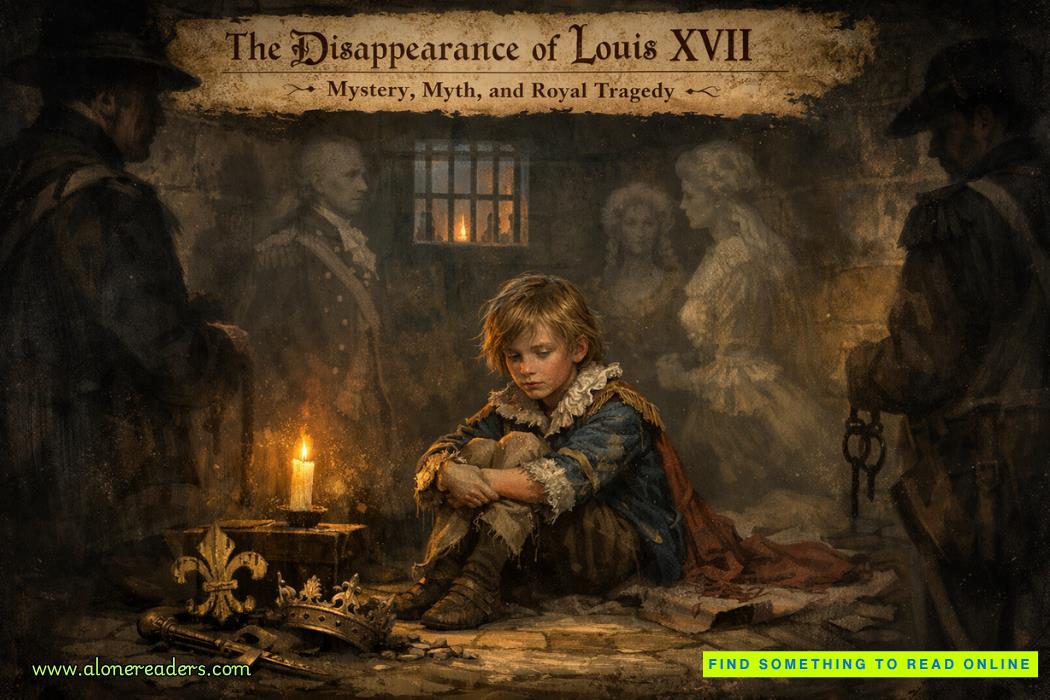
The story of Louis XVII stands as one of the most haunting enigmas of the French Revolution—a narrative suspended between documented tragedy and persistent myth. Officially, the young Dauphin died in captivity in 1795, but for over two centuries, doubts have lingered, fueled by political intrigue, inconsistent records, and a succession of impostors claiming royal identity. His disappearance is not merely a historical curiosity; it represents the collapse of monarchy, the brutality of revolutionary fervor, and the enduring human desire to believe that lost heirs might return.
Born in 1785 as Louis-Charles, the second son of King Louis XVI and Queen Marie Antoinette, he was not initially destined for the throne. His elder brother, Louis-Joseph, held that position until his death in 1789. With that, the four-year-old Louis-Charles became Dauphin of France, inheriting not only a title but also the weight of a crumbling monarchy. The French Revolution had already begun, and the royal family’s fate was becoming increasingly precarious.
The turning point came in August 1792, when revolutionary forces stormed the Tuileries Palace. The royal family was arrested and imprisoned in the Temple Tower in Paris. Following the execution of Louis XVI in January 1793, royalists across Europe recognized the young boy as King Louis XVII, even though he remained a prisoner. From that moment, his existence became both symbolic and politically explosive. To the revolutionaries, he represented a dangerous focal point for counter-revolution; to monarchists, he was the rightful king whose survival was essential.
The conditions of his imprisonment deteriorated rapidly. Initially, he remained with his mother and sister, but in July 1793, he was forcibly separated from them. This separation marked the beginning of a period of intense neglect and psychological trauma. He was placed under the care of a cobbler named Antoine Simon, who was tasked with “re-educating” the child into a republican citizen. Reports from this period describe forced indoctrination, physical abuse, and attempts to coerce the boy into denouncing his own mother.
Isolation and Decline
After Simon left his post in January 1794, the child was effectively abandoned within the prison. Guards rarely attended to him, and he was left in a dark, filthy room with minimal food and no companionship. Witnesses later described his condition as shocking: emaciated, covered in sores, and barely able to speak. This phase of neglect coincided with the Reign of Terror, when the revolutionary government was preoccupied with purging enemies and consolidating power.
By mid-1795, the boy was gravely ill. Official records state that he died on June 8, 1795, at the age of ten. An autopsy was conducted, and a death certificate was issued. However, even at this stage, inconsistencies began to emerge. The attending physician, Philippe-Jean Pelletan, removed the child’s heart—a practice sometimes performed for royalty—but the body itself was buried quickly and without ceremony in a mass grave. This lack of transparency would later fuel suspicions that the real Dauphin had not died at all.
Seeds of Doubt
The immediate aftermath of his reported death saw little public skepticism, as France was still engulfed in revolutionary chaos. However, as political stability returned under the Directory and later Napoleon, rumors began to circulate. Several factors contributed to these doubts. First, very few people had seen the child during his final months, making identification difficult. Second, the revolutionary government had a clear motive to eliminate the symbol of monarchy while possibly concealing the truth. Third, the rapid burial and absence of a clearly identifiable body created fertile ground for speculation.
By the early 19th century, stories began to emerge suggesting that Louis XVII had been secretly removed from the Temple and replaced by another child who died in his place. These narratives often involved sympathetic guards, clandestine royalist networks, or foreign agents orchestrating an escape. While no definitive evidence supported these claims, they resonated deeply with a population still grappling with the trauma of revolution.
The Era of Impostors
Perhaps the most remarkable aspect of the Louis XVII mystery is the sheer number of individuals who claimed to be the lost Dauphin. Historians have documented over one hundred such claimants, each presenting varying degrees of plausibility. Among them, Karl Wilhelm Naundorff stands out as the most prominent.
Naundorff appeared in the 1830s, asserting that he had escaped the Temple and lived in obscurity for decades. He managed to convince several former courtiers and even members of the royal household of his authenticity. His detailed recollections of life at Versailles and his knowledge of court rituals lent credibility to his claims. He pursued legal recognition of his identity and even established a small following.
However, critics pointed out inconsistencies in his story, and official authorities rejected his claims. Despite this, Naundorff maintained his position until his death in 1845, and his descendants continued to assert royal lineage. Other impostors followed similar patterns, capitalizing on gaps in historical records and the enduring allure of a lost king.
Political and Psychological Dimensions
The persistence of the Louis XVII myth cannot be understood purely as a historical anomaly. It reflects deeper political and psychological currents. For monarchists, the idea that the Dauphin survived offered hope for restoration. It allowed them to imagine that the revolutionary rupture had not been complete, that legitimacy still existed somewhere in exile.
On a psychological level, the story taps into a universal archetype—the lost heir who will return. This motif appears across cultures and eras, from medieval legends to modern fiction. In the case of Louis XVII, the harsh reality of a child dying in captivity was difficult to accept, prompting many to embrace alternative narratives.
Modern Scientific Resolution
The mystery persisted well into the 20th century, but advances in forensic science eventually provided a more definitive answer. The preserved heart removed during the autopsy in 1795 had been kept through various transfers and was eventually subjected to DNA analysis in the late 1990s.
Scientists compared the DNA from the heart with that of living descendants of Marie Antoinette’s family line. The results were conclusive: the heart belonged to a child maternally related to the queen. This strongly supports the conclusion that Louis XVII did indeed die in the Temple prison in 1795.
While this evidence resolves the biological question, it does not entirely extinguish the myth. Skeptics continue to question the chain of custody of the heart or propose alternative explanations. Nevertheless, the scientific consensus overwhelmingly supports the official account of his death.
Legacy and Historical Significance
The disappearance of Louis XVII occupies a unique place in history because it blurs the boundary between fact and legend. Unlike many historical mysteries, this one is deeply intertwined with a major political upheaval, making it both a personal tragedy and a symbol of systemic transformation.
His story highlights the human cost of revolution. Amid the grand narratives of liberty and equality, a child was subjected to isolation, neglect, and ultimately death. This contrast serves as a sobering reminder that political movements, however justified, can produce profound individual suffering.
At the same time, the enduring fascination with Louis XVII underscores the power of narrative in shaping historical memory. The persistence of impostor claims and alternative theories demonstrates how gaps in documentation and emotional resonance can sustain myths for generations.
In modern France, the figure of Louis XVII is less politically charged but remains culturally significant. He appears in literature, film, and historical discourse as a symbol of innocence lost and the fragility of legitimacy. His story continues to captivate not because of unresolved facts, but because of the emotional and symbolic weight it carries.
Ultimately, the disappearance of Louis XVII is not just about whether a boy died or escaped. It is about how societies process trauma, construct meaning, and reconcile the tension between evidence and belief. The official conclusion may be settled, but the mystery endures in the collective imagination—a testament to the enduring power of history’s unanswered questions.



 The Hundred Days Offensive: How the Allies Defeated Germany in World War I
 The Second Battle of the Marne: The Turning Point of World War I in 1918
 The Spring Offensive of 1918: Germany's Final Gamble to Win World War I
 The Treaty of Brest-Litovsk: How Russia Left World War I
 The Russian Revolution and World War I: How War Brought Down the Tsar
 The Zimmermann Telegram Explained: Germany's Secret Offer to Mexico in World War I