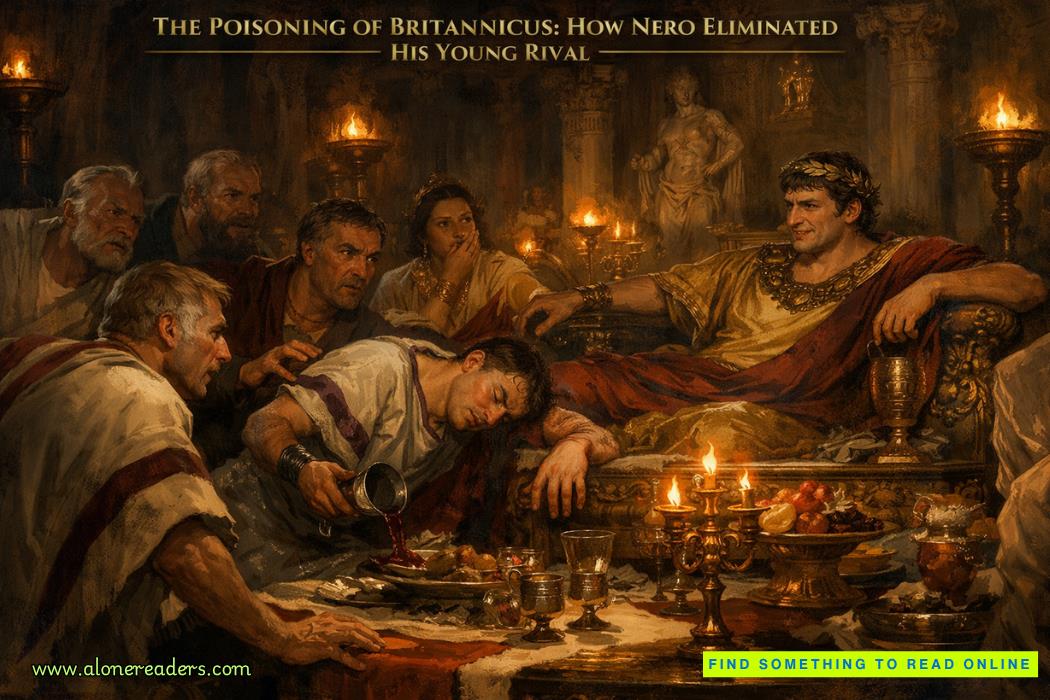
The poisoning of Britannicus in 55 AD stands as one of the most chilling and revealing episodes of early Roman imperial politics, exposing the ruthless mechanisms through which power was secured and preserved within the Julio-Claudian dynasty. Far from being an impulsive act of cruelty, the murder of Britannicus was a carefully orchestrated political maneuver designed to eliminate the last legitimate challenger to Nero’s authority. Beneath the façade of imperial stability lay a volatile environment shaped by dynastic legitimacy, maternal ambition, senatorial manipulation, and the ever-present threat of succession disputes.
Britannicus, the biological son of Emperor Claudius, embodied a direct and potent claim to the Roman throne. Unlike Nero, who had been adopted into the imperial line through the calculated ambitions of his mother Agrippina the Younger, Britannicus represented continuity of bloodline. This distinction alone made him a focal point for factions dissatisfied with Nero’s rule. As he approached maturity, the threat he posed was no longer theoretical—it became immediate, visible, and politically dangerous.
The Fragile Legitimacy of Nero
Nero’s rise to power was neither organic nor uncontested. His accession in 54 AD followed the suspicious death of Claudius, widely believed to have been poisoned—likely by Agrippina herself—to secure her son’s elevation. While adoption had precedent in Roman imperial succession, it did not erase the symbolic and political weight of biological inheritance. Britannicus, though younger, retained an intrinsic legitimacy that Nero could never fully replicate.
Initially, Nero’s rule was supported by key figures such as Seneca and Burrus, who sought to guide the young emperor toward moderation. However, their influence could not entirely neutralize the structural instability caused by Britannicus’ presence. Roman elites understood that succession was rarely settled by decree alone; it required the elimination—or at least neutralization—of alternative claimants.
As Britannicus grew older, he began to attract attention not only from disaffected senators but also from those within the imperial household who resented Agrippina’s dominance. His coming of age represented a turning point. Once he reached the threshold of political participation, he could be used as a rallying figure for opposition. For Nero, allowing Britannicus to live meant tolerating a constant, escalating threat.
Agrippina’s Diminishing Control
Ironically, the very architect of Nero’s rise—Agrippina—played an indirect role in accelerating Britannicus’ demise. Initially, she exercised immense influence over her son, effectively co-ruling during the early phase of his reign. However, Nero gradually sought to assert independence, distancing himself from his mother’s control.
This shift created a volatile internal dynamic. Agrippina, aware of her waning authority, began to subtly position Britannicus as a potential alternative. While she did not openly support him, her gestures—such as invoking his legitimacy or referencing Claudius’ lineage—were interpreted as implicit threats to Nero. In the logic of imperial politics, even symbolic support could be fatal.
For Nero, this was intolerable. Britannicus was no longer merely a rival claimant; he had become a tool in a broader power struggle within the imperial household. Eliminating him would not only remove a political threat but also weaken Agrippina’s leverage.
The Banquet and the Poison
The method chosen for Britannicus’ assassination reflects the sophistication and calculated nature of Roman political violence. According to historical accounts, the murder took place during a formal banquet—a setting designed to project unity, luxury, and imperial control.
The choice of poison was deliberate. Nero employed the services of Locusta, a notorious poisoner, to create a substance capable of killing swiftly while minimizing suspicion. The initial attempt reportedly failed, prompting Nero to demand a more potent formulation. This detail underscores the premeditated and iterative nature of the plot.
During the banquet, Britannicus was served a drink that had been cooled—standard practice in Roman dining. The poison was introduced during this process, allowing it to bypass earlier safeguards. Shortly after consuming the beverage, Britannicus collapsed, experiencing convulsions and respiratory distress.
Nero’s reaction was equally calculated. He dismissed the incident as an epileptic seizure, a condition Britannicus was rumored to suffer from. This explanation, while superficially plausible, was part of a broader strategy to control the narrative and prevent immediate backlash.
Public Perception and Elite Response
The reaction to Britannicus’ death was marked by a mixture of fear, resignation, and silent acknowledgment. Few among the Roman elite were deceived by Nero’s explanation. The suddenness of the death, combined with the political context, made the true cause evident to those familiar with imperial dynamics.
However, the capacity to act on this knowledge was severely constrained. Open opposition to the emperor carried immense risk, particularly in a system where accusations of treason could lead to swift execution. As a result, dissent was largely suppressed, manifesting only in private conversations and subtle shifts in allegiance.
The Senate, in particular, demonstrated its characteristic pragmatism. Rather than challenge Nero, it accepted the official narrative, prioritizing stability over confrontation. This response highlights a recurring feature of Roman political culture: the preference for order, even at the cost of moral compromise.
The Elimination of Dynastic Competition
With Britannicus dead, Nero achieved a critical objective: the consolidation of his position as the uncontested ruler of Rome. The removal of a legitimate heir eliminated the most immediate source of dynastic competition, allowing Nero to govern without the constant threat of internal challenge.
However, this victory came at a cost. The manner of Britannicus’ death reinforced perceptions of Nero as a ruler willing to employ extreme measures to secure power. This reputation would later contribute to a climate of fear and suspicion, shaping both his policies and his relationships with the Roman elite.
In a broader sense, the assassination reflects the inherent instability of hereditary monarchy within the Roman context. Unlike later dynasties with established succession protocols, the Julio-Claudian system relied heavily on personal alliances, adoptions, and informal power structures. This ambiguity created an environment in which violence became a primary tool for resolving disputes.
Psychological and Symbolic Dimensions
Beyond its political implications, the poisoning of Britannicus carries significant psychological and symbolic weight. The act of killing a young, vulnerable rival during a public banquet underscores the extent to which personal relationships were subordinated to political necessity.
Nero and Britannicus were not merely political adversaries; they were members of the same household, bound by complex familial ties. The decision to murder Britannicus in such a setting represents a profound rupture in the moral fabric of the imperial family.
Symbolically, the event marked the окончательное переход of Nero’s reign from guided governance to autonomous rule. By orchestrating the assassination, Nero demonstrated both his willingness and his ability to act independently, even in matters of life and death. This transition would have far-reaching consequences, influencing the trajectory of his reign and the nature of his interactions with both allies and adversaries.
Historical Interpretation and Legacy
The primary accounts of Britannicus’ death come from Roman historians such as Tacitus, Suetonius, and Cassius Dio, each of whom presents the event within a broader critique of Nero’s character. While their narratives are shaped by literary and moral agendas, they converge on key details, reinforcing the credibility of the core account.
Modern historians approach these sources with a degree of skepticism, recognizing the potential for exaggeration and bias. However, the consistency of the narrative, combined with the broader context of Nero’s reign, supports the conclusion that Britannicus’ death was indeed the result of deliberate poisoning.
The legacy of the event extends beyond the immediate circumstances of Nero’s rule. It serves as a case study in the dynamics of power within autocratic systems, illustrating how legitimacy, perception, and violence intersect in the struggle for control. The poisoning of Britannicus is not merely an isolated incident; it is emblematic of a broader pattern in which political survival often necessitates extreme measures.
Conclusion: Power Secured Through Elimination
The poisoning of Britannicus represents a decisive moment in the early Roman Empire, encapsulating the brutal realities of dynastic politics. Through a combination of strategic calculation, psychological manipulation, and outright violence, Nero eliminated his most significant rival, securing his position at the apex of Roman power.
Yet, this act of consolidation also sowed the seeds of future instability. By demonstrating a willingness to eliminate even the most vulnerable threats, Nero reinforced a culture of fear that would ultimately undermine his own authority. In this sense, the death of Britannicus was both a triumph and a turning point—a moment in which power was secured, but at the cost of legitimacy and trust.
In the final analysis, the story of Britannicus is not merely about a young prince who fell victim to imperial ambition. It is about the structural forces that shaped Roman politics, the individuals who navigated those forces, and the enduring consequences of decisions made in the pursuit of absolute power.



 The Hundred Days Offensive: How the Allies Defeated Germany in World War I
 The Second Battle of the Marne: The Turning Point of World War I in 1918
 The Spring Offensive of 1918: Germany's Final Gamble to Win World War I
 The Treaty of Brest-Litovsk: How Russia Left World War I
 The Russian Revolution and World War I: How War Brought Down the Tsar
 The Zimmermann Telegram Explained: Germany's Secret Offer to Mexico in World War I