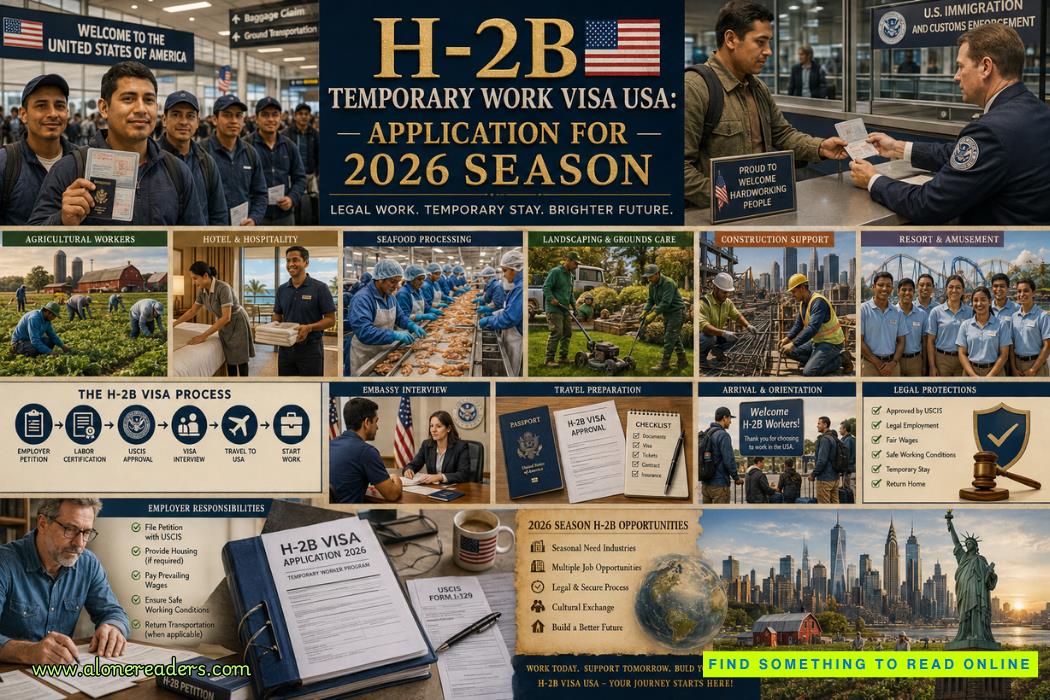
The H-2B Temporary Non-Agricultural Worker Visa remains one of the most important pathways for foreign nationals seeking short-term employment opportunities in the United States. Every year, thousands of workers travel to America under the H-2B program to fill temporary labor shortages in industries that cannot find enough available U.S. workers. For the 2026 season, demand for H-2B workers is expected to remain extremely high due to labor shortages across hospitality, tourism, landscaping, seafood processing, forestry, amusement parks, and construction support services.
Unlike immigrant visas that lead directly to permanent residency, the H-2B visa is strictly temporary. It allows foreign workers to enter the United States for a defined period to perform non-agricultural labor or services for a sponsoring employer. The entire system is employer-driven, meaning a worker cannot independently apply for an H-2B visa without a valid U.S. employer sponsor.
For many applicants, the H-2B visa represents a major economic opportunity. Workers can legally earn U.S. wages, gain international work experience, and support families back home. However, the application process is highly regulated, quota-controlled, time-sensitive, and documentation-heavy. Understanding the exact process for the 2026 season is critical because mistakes can lead to denial, delays, or visa ineligibility.
The H-2B visa category was created to help U.S. employers meet temporary labor demands when qualified American workers are unavailable. The program applies only to non-agricultural jobs. Agricultural labor is handled separately under the H-2A visa program.
Temporary need is the foundation of the H-2B system. A U.S. employer must prove that the labor requirement is temporary and fits one of the following categories:
One-Time Occurrence
The employer has not previously hired workers for the position and does not expect to need workers again in the future.
Seasonal Need
The labor demand occurs during a predictable seasonal cycle, such as summer tourism or winter resort operations.
Peak Load Need
The employer needs additional workers during busy operational periods beyond regular staffing levels.
Intermittent Need
The employer occasionally requires workers for short periods but does not employ permanent workers for the role.
The U.S. government carefully evaluates these conditions because the H-2B program is designed to supplement—not replace—the domestic workforce.
Several sectors heavily depend on H-2B workers each year. For the 2026 season, labor demand is expected to remain strong in the following industries:
Hospitality and Tourism
Hotels, resorts, theme parks, restaurants, and vacation destinations frequently recruit H-2B workers during peak tourist seasons.
Landscaping and Groundskeeping
Landscaping companies across the United States consistently use H-2B workers for lawn maintenance, gardening, irrigation, and outdoor property management.
Seafood Processing
Coastal states often rely on temporary workers for fish processing, crab picking, shrimp packaging, and seasonal seafood production.
Forestry and Conservation
Tree planting, wildfire prevention support, forest maintenance, and conservation operations commonly recruit temporary foreign labor.
Construction Support Services
Some temporary construction-related roles may qualify if the work is seasonal and non-permanent.
Carnivals and Entertainment
Traveling amusement operators and event companies regularly hire temporary workers for rides, maintenance, food operations, and event setup.
These industries typically begin recruitment many months before the actual work season starts, meaning early preparation is essential.
One of the most important aspects of the H-2B visa program is the annual numerical cap.
The standard annual limit is 66,000 visas per fiscal year, divided into two halves:
Demand often exceeds available slots extremely quickly. In many years, the cap has been reached within days of filing openings.
Because of labor shortages, the U.S. government occasionally authorizes supplemental H-2B visas beyond the standard cap. These additional allocations are usually targeted toward returning workers or nationals from specific countries.
For the 2026 season, applicants should closely monitor employer timelines because filing delays can cause workers to miss the quota entirely.
The United States maintains an approved list of countries whose nationals are generally eligible for H-2B participation. The list can change annually depending on diplomatic cooperation, immigration compliance, and security considerations.
Workers from countries with strong participation histories often have smoother processing experiences because U.S. authorities are already familiar with labor migration patterns from those regions.
However, eligibility based on nationality alone does not guarantee visa approval. Each applicant must still satisfy all legal and procedural requirements.
The employer carries most of the legal burden in the H-2B process.
Temporary Labor Certification
Before sponsoring foreign workers, the employer must obtain temporary labor certification from the U.S. Department of Labor. This certification confirms:
Recruitment of U.S. Workers
The employer must actively recruit American workers before turning to foreign labor. This includes job advertisements, workforce agency postings, and documented recruitment efforts.
Filing Petition with USCIS
After labor certification approval, the employer submits Form I-129 to U.S. Citizenship and Immigration Services.
Providing Employment Conditions
Employers must comply with wage laws, work-hour commitments, housing obligations if applicable, transportation rules, and worker protections.
Violations can lead to severe penalties, disqualification from future participation, and federal investigations.
Foreign workers seeking H-2B visas must satisfy multiple requirements.
Valid Job Offer
A worker must have a confirmed offer from a U.S. employer approved under the H-2B system.
Intent to Return Home
Applicants must demonstrate nonimmigrant intent, meaning they plan to leave the United States after temporary employment ends.
Background and Security Clearance
Applicants undergo security screening, criminal background checks, and immigration history reviews.
Passport Validity
Passports should remain valid for the intended duration of stay and usually beyond the projected departure date.
Embassy Interview Compliance
Applicants must successfully complete the U.S. embassy or consulate interview process.
Even with employer sponsorship, consular officers retain authority to approve or deny visas based on immigration law.
Step 1: Employer Recruitment and Job Offer
The process begins when a U.S. employer identifies labor shortages and recruits foreign workers either directly or through licensed recruiting agencies.
Workers should carefully verify:
Fraudulent recruiters remain a serious problem in international labor migration.
Step 2: Labor Certification Approval
The employer files for temporary labor certification with the Department of Labor. Processing timelines vary depending on workload and seasonality.
Without labor certification approval, the process cannot continue.
Step 3: USCIS Petition Filing
The employer submits Form I-129 to USCIS requesting authorization to hire foreign workers.
Once approved, USCIS issues a Notice of Approval.
Step 4: Visa Application Submission
Workers complete the DS-160 online nonimmigrant visa application form and pay the required visa fee.
Applicants then schedule embassy interviews.
Step 5: Embassy Interview
The interview is one of the most critical stages.
Consular officers typically evaluate:
Applicants should answer honestly, consistently, and confidently.
Step 6: Visa Issuance and Travel
If approved, the visa is placed in the applicant’s passport. Workers can then travel to the United States before employment begins.
At the port of entry, U.S. Customs and Border Protection officers make the final admission decision.
Although documentation varies by embassy and employer, most applicants need:
Incomplete documentation frequently causes delays or refusals.
The H-2B visa is temporary by design.
Initial stays are usually granted according to the approved employment period, often several months up to one year.
Extensions may be possible if the employer continues to demonstrate temporary need. However:
Long-term unauthorized stays can create severe immigration consequences.
H-2B workers are legally protected under U.S. labor laws.
Employers must pay at least the prevailing wage determined by federal authorities. They cannot legally underpay foreign workers simply because they are temporary employees.
Workers are generally protected regarding:
The U.S. government has increased scrutiny of labor exploitation cases involving temporary worker programs.
Several issues commonly lead to denials.
Weak Employer Documentation
If the temporary need is poorly documented, certification or petition approval may fail.
Suspicious Recruitment Activity
Fraudulent recruiters or fake job offers create major risks.
Immigration Intent Concerns
Applicants who appear likely to overstay may face refusal.
Incomplete Forms
Errors in DS-160 forms or inconsistent information can create credibility issues.
Prior Immigration Violations
Overstays, deportations, unauthorized work, or visa fraud may affect eligibility.
Because H-2B visas are highly desirable, scams are widespread.
Applicants should avoid:
Legitimate U.S. employers and licensed recruiters usually provide transparent documentation and formal agreements.
Timing is critical for H-2B applications.
Many employers begin preparing labor certifications several months before the actual employment season starts. Workers who delay passport renewal, documentation gathering, or interview preparation may lose opportunities due to quota exhaustion.
For the 2026 season, applicants should focus on:
The H-2B visa program remains one of the most practical legal pathways for temporary employment in the United States. However, success depends heavily on preparation, documentation accuracy, employer legitimacy, and timing. As labor shortages continue across multiple American industries, the 2026 H-2B season is expected to attract intense global competition. Applicants who understand the process deeply and prepare strategically will have a significantly stronger chance of successfully obtaining temporary work authorization in the United States.



 Qatar Temporary Work Visa 180 Days 2026: Complete Eligibility, Application Process, Documents, Costs, Extension Rules, and Employment Guide
 Canada Intra-Company Transfer Work Permit 2026: Complete Guide to Eligibility, Requirements, Application Process, and Employer Responsibilities
 UK Study English Language Visa 2026: Complete Guide to Eligibility, Requirements, Costs, Application Process, and Student Life
 UK Expansion Worker Visa Intra-Company 2026: Complete Guide to Eligibility, Sponsorship, Costs, Business Expansion, and Application Process
 High-End Talent Category A Work Permit China 2026: Complete Eligibility, Benefits, Application Process, and Expert Guide
 Cultural Activities Visa Japan 2026 Guide: Complete Eligibility, Requirements, Application Process, and Expert Tips