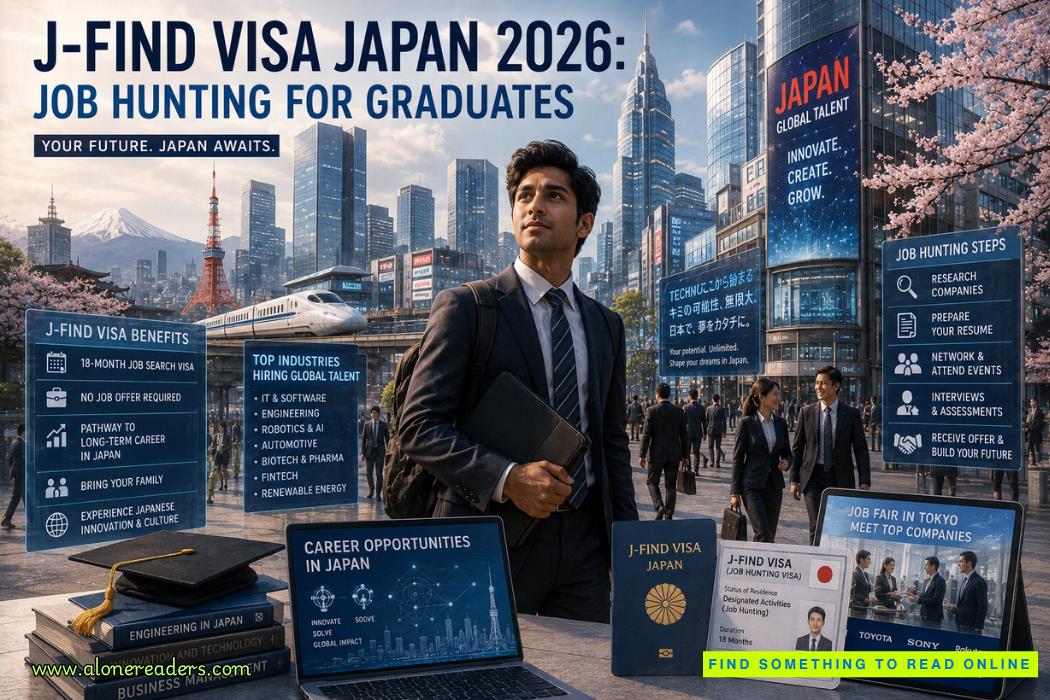
Japan has traditionally maintained one of the most structured immigration systems in Asia, particularly regarding employment-based migration. However, the country’s long-term demographic challenges, labor shortages, declining birth rates, and increasing competition for global talent have pushed the Japanese government to modernize its immigration strategy. One of the most important outcomes of this shift is the J-Find Visa, a relatively new immigration pathway designed specifically for highly educated international graduates who want to live in Japan while searching for work or preparing to launch entrepreneurial activities.
For graduates from internationally recognized universities, the J-Find Visa represents a unique opportunity. Unlike conventional work visas that require a confirmed employer sponsorship before entering Japan, this visa allows eligible individuals to enter Japan first and conduct job hunting activities legally inside the country. This changes the traditional immigration dynamic significantly and creates a much more flexible route for young professionals interested in Japanese careers.
In 2026, the J-Find Visa continues to attract attention among graduates in engineering, information technology, artificial intelligence, finance, robotics, biotechnology, research, business analytics, and advanced manufacturing. Japan’s increasing dependence on international professionals means the visa is becoming strategically important not only for applicants but also for Japanese companies struggling with labor shortages and global expansion.
What the J-Find Visa Actually Is
The official structure behind the J-Find Visa is connected to Japan’s effort to attract “highly educated foreign nationals.” The program was designed to provide talented graduates from top-ranked universities with a temporary residence status allowing them to stay in Japan while pursuing employment or entrepreneurial preparation.
The visa differs substantially from standard Japanese work visas because applicants are not required to secure employment before arrival. Instead, the government grants a period of legal residence specifically for career exploration, networking, interviews, internship discussions, startup planning, and business preparation.
This is a major advantage because many Japanese companies strongly prefer candidates who are already physically present in Japan. Local presence allows employers to evaluate communication skills, cultural adaptability, Japanese language capability, and long-term commitment more effectively.
Educational Qualification Standards
The most critical requirement involves graduation from a recognized top-tier university. Japan maintains a list of eligible institutions based on international rankings from globally recognized ranking systems.
Generally, applicants must have graduated from a university ranked within the top global institutions during a specified period. The degree can usually include:
The graduation date is also extremely important. In most cases, applicants must have completed their degree within the previous five years before applying.
This requirement means the program primarily targets relatively recent graduates rather than highly experienced professionals already established in long-term careers.
Financial Capability Requirements
Applicants must demonstrate sufficient financial resources to support themselves during their stay in Japan. Since the visa initially allows residence without employment sponsorship, immigration authorities want assurance that applicants can manage living expenses independently.
Typical financial evidence may include:
Japan’s immigration system generally evaluates whether the applicant can realistically sustain accommodation, transportation, food, insurance, and daily living costs.
How Long the Visa Allows You to Stay
The J-Find Visa generally allows eligible individuals to stay in Japan for up to two years. This is particularly significant because it provides enough time for serious job hunting efforts rather than forcing graduates into rushed employment decisions.
A two-year period offers substantial flexibility for:
Compared to countries where job-seeking visas are limited to six months or one year, Japan’s approach is comparatively generous.
Industries with Strong Hiring Demand
Japan’s labor shortages are especially severe in several specialized sectors. Graduates using the J-Find Visa often target industries experiencing structural workforce deficits.
The strongest sectors include:
Japan’s major corporations increasingly recognize that domestic talent pipelines alone cannot satisfy future labor demand, especially in highly technical industries.
Technology Sector Expansion
The Japanese technology sector remains one of the strongest attractions for international graduates. Companies are investing heavily in AI systems, automation, semiconductor infrastructure, digital transformation, and smart manufacturing.
Foreign graduates with strong technical backgrounds may find opportunities in:
Tokyo, Osaka, Yokohama, Fukuoka, and Nagoya remain key technology hubs.
Is Japanese Mandatory?
One of the most misunderstood aspects of the J-Find Visa is language expectations. Technically, the visa itself does not always require advanced Japanese proficiency. However, practical employment realities differ significantly.
For many Japanese domestic companies, conversational Japanese remains extremely important. Business communication, internal reporting, meetings, and customer interaction often occur primarily in Japanese.
That said, international companies and technology-focused employers increasingly operate in English-friendly environments.
Graduates with limited Japanese proficiency may still find opportunities in:
However, learning Japanese dramatically increases employability.
Recommended Language Level
For serious long-term employment prospects, most candidates benefit substantially from achieving at least:
Language ability also influences salary potential and promotion opportunities.
Startup Preparation Opportunities
One particularly interesting feature of the J-Find Visa is its support for entrepreneurial preparation activities. Applicants are not restricted solely to job searching.
Graduates may also use the visa period to:
Japan has increasingly encouraged international entrepreneurship, particularly in technology and innovation sectors.
Cities such as Tokyo and Fukuoka have introduced startup-friendly initiatives designed to attract foreign founders.
Financial Planning Before Arrival
Japan can be expensive, especially in major urban centers. Graduates entering under the J-Find framework should prepare realistic budgets before relocation.
Approximate monthly costs in Tokyo may include:
Smaller cities may offer substantially lower living costs while still providing strong employment opportunities.
Finding Accommodation in Japan
Housing remains one of the most difficult aspects for newcomers. Many landlords still hesitate to rent to foreigners due to language barriers, contract concerns, and guarantor requirements.
New graduates often rely on:
Tokyo’s rental market is especially competitive, and initial move-in costs can be substantial because of deposits, agency fees, and traditional “key money” systems.
What Happens After Securing Employment
The J-Find Visa is not intended as a permanent residence category. Once employment is secured, the applicant typically transitions into a standard Japanese work visa category.
Common transitions include:
The transition process is generally smoother once an employer sponsorship is obtained।
Why the J-Find Visa Matters Long-Term
For many graduates, the J-Find Visa is not merely a temporary job-search permit. It can become the first step toward Japan’s highly skilled migration pathways.
Japan’s Highly Skilled Professional system offers substantial advantages, including:
Graduates entering through J-Find may eventually accumulate sufficient qualifications, salary levels, and experience to qualify under this framework
Japanese Recruitment Culture
Job searching in Japan differs considerably from Western recruitment systems. Understanding cultural expectations can significantly improve success rates.
Employers often evaluate:
Interview preparation may involve:
Even highly technical employers frequently value professionalism and communication as much as technical ability.
Why Graduates Are Considering Japan
Several factors make the J-Find Visa increasingly attractive compared to graduate pathways elsewhere.
Key advantages include:
Japan’s global reputation in robotics, automotive engineering, electronics, AI, and manufacturing also enhances career prestige for international graduates.
Reality Beyond the Marketing
Despite its advantages, the J-Find Visa is not without challenges.
Graduates may encounter:
Japanese hiring cycles can also differ significantly from international recruitment timelines, particularly among large corporations that recruit in structured annual cycles.
How Applicants Can Improve Their Outcomes
The most successful J-Find applicants typically prepare extensively before arriving in Japan.
Strong preparation strategies include:
Graduates who arrive with realistic expectations and clear career strategies generally achieve better outcomes.
Japan’s Long-Term Immigration Direction
Japan’s demographic trajectory strongly suggests that international recruitment will continue expanding through the late 2020s and beyond.
The country faces:
As a result, policies like the J-Find Visa are likely to become increasingly important rather than temporary experimental programs.
Future developments may include:
The J-Find Visa Japan 2026 program represents one of the most strategically important graduate migration pathways currently available in Asia. It fundamentally changes how international graduates can access Japanese employment markets by removing the traditional requirement of securing sponsorship before arrival.
For highly educated graduates interested in technology, engineering, business innovation, research, or entrepreneurship, the visa offers a rare combination of flexibility, opportunity, and long-term career potential.
However, success under the program requires more than academic credentials alone. Language preparation, cultural understanding, financial planning, and strategic networking remain essential components of building a successful career in Japan.
As Japan continues adapting to economic transformation and demographic pressures, international graduates entering through the J-Find Visa pathway may increasingly become part of the country’s future professional workforce, innovation ecosystem, and global economic strategy.



 Qatar Temporary Work Visa 180 Days 2026: Complete Eligibility, Application Process, Documents, Costs, Extension Rules, and Employment Guide
 Canada Intra-Company Transfer Work Permit 2026: Complete Guide to Eligibility, Requirements, Application Process, and Employer Responsibilities
 UK Study English Language Visa 2026: Complete Guide to Eligibility, Requirements, Costs, Application Process, and Student Life
 UK Expansion Worker Visa Intra-Company 2026: Complete Guide to Eligibility, Sponsorship, Costs, Business Expansion, and Application Process
 High-End Talent Category A Work Permit China 2026: Complete Eligibility, Benefits, Application Process, and Expert Guide
 Cultural Activities Visa Japan 2026 Guide: Complete Eligibility, Requirements, Application Process, and Expert Tips