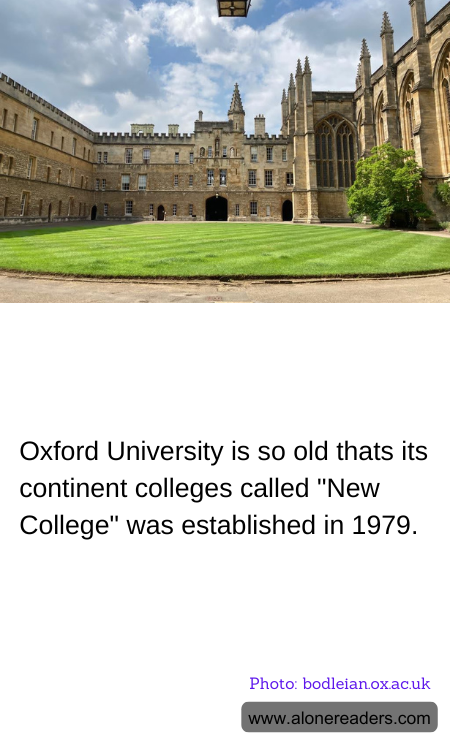
Oxford University, famed for its rich history and profound academic legacy, is among the oldest universities in the world, with its origins tracing back to at least the 12th century. It comprises a complex of colleges and halls that contribute to the overall framework of the institution. Among these, New College stands out, notably because of its name which might suggest a more modern origin. However, contrary to what might be implied by the date 1979, New College was actually founded much earlier, in 1379 by William of Wykeham, Bishop of Winchester. It was originally named ‘The College of St Mary of Winchester in Oxford’ and is one of the principal Gothic buildings of England, admired for its architectural beauty and historical significance.
The confusion might arise from its name, "New College," which is indeed a misnomer by modern standards. When it was established, it was new compared to the already existing colleges of Oxford at that time, such as University College, Balliol, and Merton, which were founded in the 13th century. The name was meant to distinguish it from the older existing colleges, particularly from the even older St. Mary's College, which is now no longer in existence.
Over the centuries, New College has maintained its reputation for academic excellence and has been home to a wide range of scholars, politicians, and artists who have significantly impacted society. The college’s architecture, too, speaks volumes of its historic past; its cloisters, chapel, and gardens are prime examples of medieval construction and are often explored not just by students of history, but also by tourists.
Despite the implication of its name and the misinterpretation that could arise from a modern perspective, New College is a deeply entrenched part of Oxford’s long and storied heritage, reflecting the evolutionary nature of educational institutions which can maintain traditional names that no longer literally apply to their present state. This is a testament to the preservation of history and traditions that is often characteristic of educational establishments with such rich legacies.
