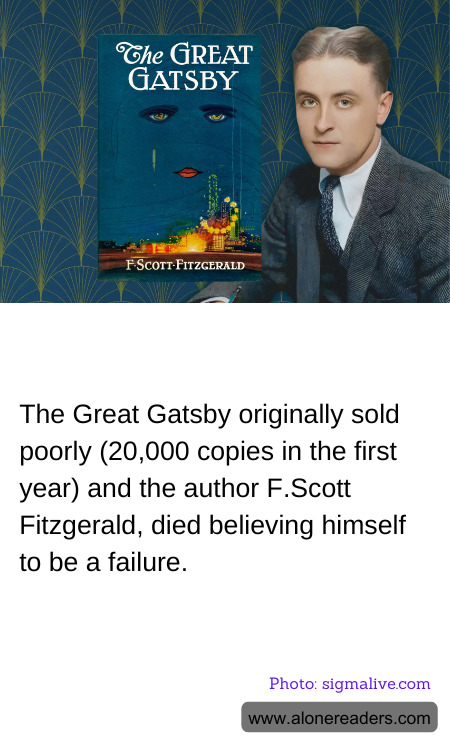
Published in 1925, "The Great Gatsby" by F. Scott Fitzgerald is today heralded as a masterpiece of American literature, capturing the essence of an era through its poignant exploration of themes like the American Dream, decadence, and idealism. However, the initial reception of the novel was far from what one might expect for a work that would later be considered a cornerstone of 20th-century American fiction. In its first year, "The Great Gatsby" sold a mere 20,000 copies—a disappointing figure for Fitzgerald, who had achieved literary celebrity with his earlier works.
Fitzgerald's disappointment with the novel’s initial reception deepened over the years as he confronted various personal and professional struggles, including financial difficulties and his wife Zelda's mental health issues. He was periodically plagued by alcoholism, which affected his writing career and reputation during his lifetime. Despite his early success with novels like "This Side of Paradise" and "The Beautiful and Damned," Fitzgerald came to view himself as a failure, a sentiment exacerbated by the commercial failure of “The Great Gatsby.”
By the time of his death in 1940, Fitzgerald was relatively obscure, and he died believing that his work would not endure. Little did he know, "The Great Gatsby" would undergo a spectacular revival during World War II when it was distributed in paperback editions to American soldiers. This move significantly boosted its readership and sparked renewed interest in all of Fitzgerald’s works. Post-war, the novel began to be appreciated for its rich symbolism, complex characters, and keen social insights, eventually becoming a staple of American high school and college curriculums and inspiring numerous adaptations, including several films and stage performances.
Today, "The Great Gatsby" is widely regarded as a literary classic, frequently cited for its sharp critique of the American upper classes and its stark depiction of the disillusionment that can lie beneath the surface of the American Dream. Its initial commercial failure is a poignant reminder of the often unpredictable nature of literary success and the posthumous recognition that some artists receive only after their time. Fitzgerald’s legacy, once clouded by personal despair and professional obscurity, now shines as a testament to the lasting impact of his keen insights into the American psyche and society.
