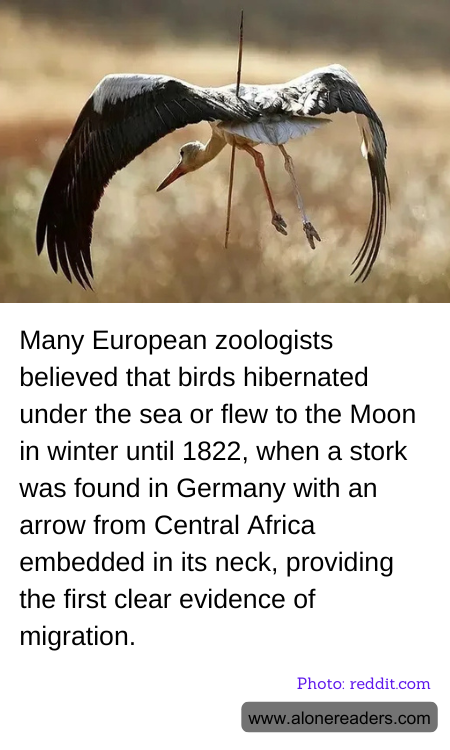
For centuries, the mystery of where birds disappeared to during the harsh European winters puzzled naturalists and laypeople alike. Before the 19th century, many European zoologists held fascinating yet erroneous beliefs about avian behavior. Some speculated that birds hibernated under the sea, while others entertained the whimsical notion that they flew to the Moon to escape the cold. These theories, though imaginative, were based on the limited scientific understanding of the time and the absence of concrete evidence to suggest otherwise.
The turning point in unraveling this mystery came in 1822 with a remarkable discovery in Germany. A stork was found with an arrow lodged in its neck, an arrow that was unmistakably of Central African origin. This stork, known as the "Pfeilstorch" or "Arrow Stork," provided the first tangible evidence that birds did not vanish into the depths of the ocean or embark on lunar voyages but instead undertook long migrations to distant lands.
The discovery of the Pfeilstorch was a pivotal moment in ornithology, the study of birds. It challenged the prevailing myths and opened the door to a new understanding of bird behavior. The arrow, a silent testament to the stork's journey, suggested that these birds traveled vast distances across continents, a concept that was both awe-inspiring and revolutionary at the time. This evidence prompted further investigation into bird migration, leading to the realization that many bird species undertake seasonal migrations, traveling thousands of miles between breeding and wintering grounds.
The revelation of bird migration not only enriched scientific knowledge but also inspired a sense of wonder and admiration for these resilient creatures. It highlighted the incredible navigational abilities of birds, which rely on a combination of environmental cues, such as the Earth's magnetic field, the position of the sun and stars, and even olfactory signals, to guide their journeys. The study of migration has since become a crucial area of research, contributing to our understanding of ecology, climate change, and conservation.
Today, the story of the Pfeilstorch serves as a reminder of the importance of questioning assumptions and seeking evidence-based explanations in science. It underscores the value of curiosity and observation in uncovering the truths of the natural world. As we continue to explore the mysteries of migration, the tale of the stork with the African arrow remains a testament to the enduring quest for knowledge and the wonders of the avian world.
