In our fast-paced modern world, time is often measured in seconds, minutes, and hours, but few people are aware that the concept of a "moment" has its roots in medieval timekeeping. In medieval times, a moment was a recognized unit of time, and it was precisely defined as 1.5 minutes. This fascinating tidbit of history reveals how our ancestors viewed and measured time in a manner that is both intriguing and surprisingly practical.
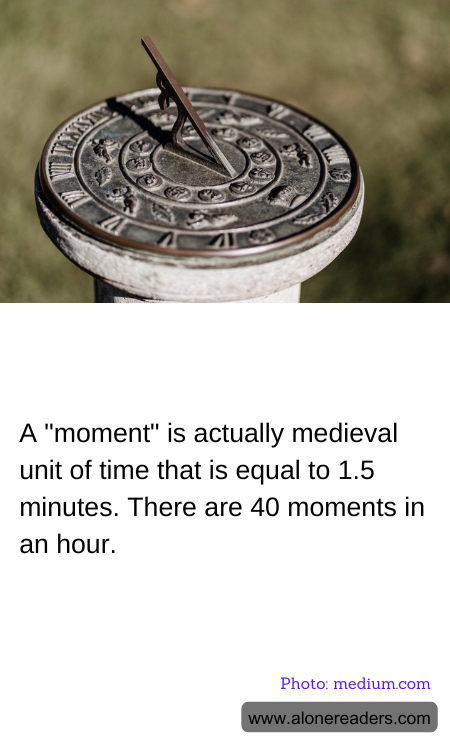
The medieval moment was part of a broader system of timekeeping that was less rigid than our current system. During this period, an hour was divided into 40 moments, making each moment equal to 90 seconds. This division allowed for a more flexible approach to time management, which was particularly useful in an era when the precision of modern clocks was not yet available. Instead of relying on the ticking of a clock, people would often use sundials or other natural indicators to gauge the passage of time, and the concept of the moment fit well within this framework.
The use of moments in medieval times reflects a different relationship with time than we have today. In an age where life was dictated more by the rhythms of nature and less by the mechanical precision of clocks, the moment offered a way to break down time into manageable segments without the pressure of exactness. This approach allowed people to focus more on the flow of daily activities rather than the strict adherence to a schedule, which is often the case in contemporary society.
Interestingly, the notion of a moment has persisted into modern language, albeit in a more abstract form. When we say "just a moment," we are often referring to a brief, undefined period, echoing the medieval use of the term. While we may not consciously think of a moment as being 1.5 minutes, the historical definition adds a layer of depth to our understanding of this common phrase.
The medieval moment serves as a reminder of the evolution of timekeeping and how our perception of time has changed over the centuries. It highlights the adaptability of human societies in measuring and valuing time according to the tools and needs of the era. As we continue to innovate and refine our methods of tracking time, the medieval moment stands as a testament to the ingenuity of our ancestors and their ability to navigate the complexities of daily life with the resources available to them.
In a world where time is often seen as a commodity, reflecting on the medieval moment encourages us to appreciate the fluidity and richness of time as experienced by those who came before us. It invites us to consider how we might balance the precision of modern timekeeping with the more relaxed and natural rhythms that once guided human life.
