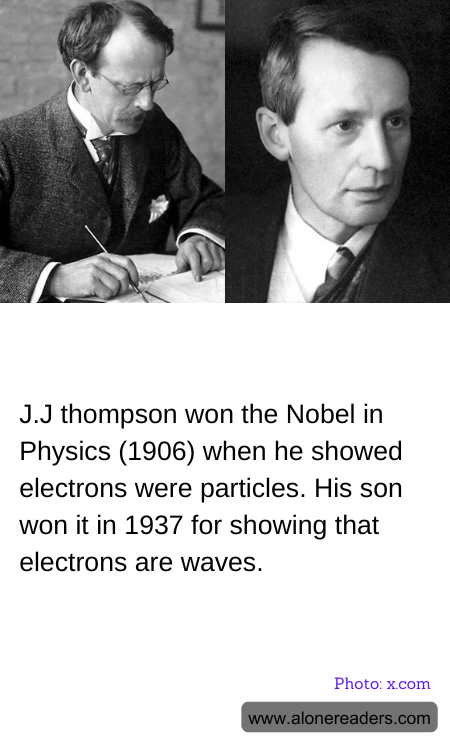
In the annals of scientific discovery, few families have contributed as profoundly to our understanding of the universe as the Thomsons. The story of J.J. Thomson and his son, George Paget Thomson, is a fascinating tale of scientific evolution and the dual nature of electrons, which has become a cornerstone of modern physics.
In 1906, J.J. Thomson was awarded the Nobel Prize in Physics for his groundbreaking work that identified the electron as a particle. His experiments with cathode rays led to the discovery of the electron, a fundamental component of the atom. By demonstrating that these rays were composed of negatively charged particles, he effectively dismantled the prevailing notion of atoms as indivisible entities. This discovery not only earned him the prestigious Nobel Prize but also laid the foundation for the development of atomic physics and the eventual understanding of atomic structure.
Fast forward to 1937, and the Nobel Prize in Physics was awarded to J.J. Thomson's son, George Paget Thomson, for his work that revealed the wave-like nature of electrons. This was a pivotal moment in the field of quantum mechanics. George Thomson's experiments involved the diffraction of electrons through thin metal foils, which produced patterns characteristic of wave interference. This phenomenon provided compelling evidence for the wave-particle duality of electrons, a concept that is central to quantum theory. His work confirmed the theoretical predictions of physicists like Louis de Broglie, who had proposed that particles such as electrons exhibit both particle and wave properties.
The contributions of the Thomson family highlight the dynamic and evolving nature of scientific understanding. J.J. Thomson's identification of the electron as a particle was a monumental step in the early 20th century, providing a new perspective on the atomic world. Yet, just a few decades later, George Thomson's work expanded this view, illustrating the complex and dual nature of matter. This duality is now a fundamental aspect of quantum mechanics, influencing everything from the development of new technologies to our philosophical understanding of reality.
The story of the Thomsons is not just a tale of scientific achievement but also a testament to the power of curiosity and the relentless pursuit of knowledge. It underscores the idea that science is a continuous journey, where each discovery builds upon the last, leading to deeper insights and more profound questions. The legacy of J.J. and George Thomson serves as an inspiration to scientists and curious minds everywhere, reminding us that the universe is full of mysteries waiting to be unraveled.
