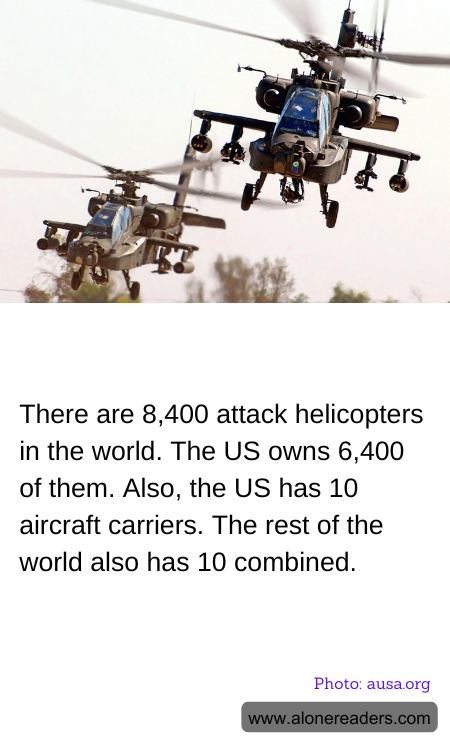
In the realm of modern military power, the United States stands as a formidable force, particularly in its aerial and naval capabilities. A striking illustration of this dominance is evident in the global distribution of attack helicopters and aircraft carriers. Out of approximately 8,400 attack helicopters worldwide, the United States owns an overwhelming 6,400. This staggering number highlights the country's commitment to maintaining air superiority and rapid response capabilities.
Attack helicopters are crucial assets in modern warfare, providing close air support, reconnaissance, and anti-tank operations. The United States' significant investment in these aircraft underscores its strategic focus on maintaining a versatile and responsive military force. This vast fleet allows the U.S. military to project power and provide support to ground forces across various terrains and conflict scenarios. The technological advancements and operational readiness of these helicopters further enhance their effectiveness, making them a cornerstone of U.S. military strategy.
In addition to its dominance in attack helicopters, the United States also leads in naval power with its fleet of aircraft carriers. The U.S. Navy operates 10 aircraft carriers, a number matched by the combined total of all other countries in the world. Aircraft carriers are pivotal in establishing naval supremacy, serving as mobile airbases that can be deployed to strategic locations worldwide. They enable the U.S. to project power, deter aggression, and provide humanitarian assistance during crises.
The presence of these carriers in international waters serves as a deterrent to potential adversaries and reassures allies of the United States' commitment to global security. The ability to launch and recover aircraft from anywhere in the world gives the U.S. a unique strategic advantage, allowing for rapid deployment and sustained operations far from its shores.
This concentration of military assets in the hands of a single nation raises important questions about global military balance and the implications for international security. While the United States' military capabilities contribute to its role as a global leader, they also necessitate responsible stewardship and diplomatic engagement to ensure stability and peace.
In conclusion, the United States' overwhelming ownership of attack helicopters and aircraft carriers underscores its unparalleled military strength. These assets not only enhance the country's defense capabilities but also play a crucial role in maintaining global security. As the world navigates complex geopolitical challenges, the strategic deployment and management of these powerful tools will continue to shape the international landscape.
