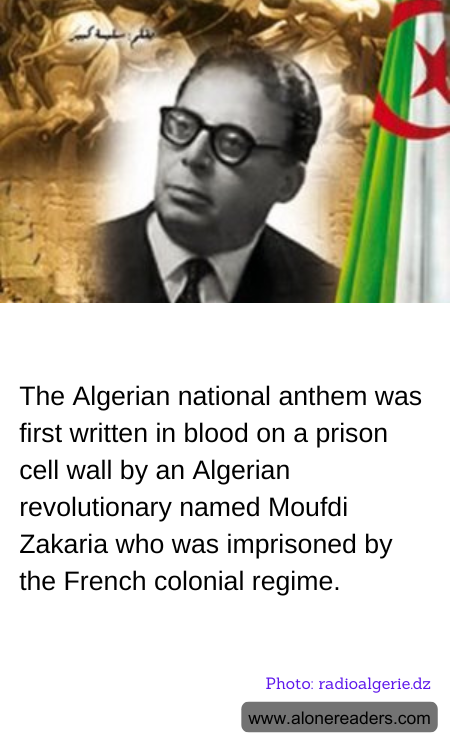
The story of the Algerian national anthem is one of resilience, defiance, and the indomitable spirit of a people yearning for freedom. It begins in the confines of a prison cell, where Moufdi Zakaria, an Algerian revolutionary and poet, found himself incarcerated by the French colonial regime. During the tumultuous years of the Algerian War of Independence, Zakaria's words would become a symbol of hope and resistance for a nation under siege.
Moufdi Zakaria was arrested by the French authorities due to his involvement in the nationalist movement that sought to liberate Algeria from colonial rule. While imprisoned, he faced harsh conditions and the constant threat of violence. Yet, it was within these oppressive walls that Zakaria's creativity and patriotism flourished. Deprived of pen and paper, he resorted to an extraordinary means of expression—writing with his own blood on the walls of his cell. This act of defiance was not just a testament to his personal courage but also a reflection of the collective struggle of the Algerian people.
The words Zakaria inscribed would later become the lyrics of "Kassaman," the national anthem of Algeria. The anthem is a powerful declaration of the nation's resolve to fight for its freedom and sovereignty. Its verses speak of sacrifice, unity, and the unwavering commitment to the cause of independence. The imagery of blood and sacrifice is poignant, capturing the essence of a revolution that demanded immense courage and resilience from its participants.
"Kassaman" was officially adopted as the national anthem of Algeria in 1963, shortly after the country gained independence from France. The anthem's stirring melody and evocative lyrics continue to resonate with Algerians, serving as a reminder of the sacrifices made by those who fought for their country's freedom. It is a testament to the power of words and the enduring spirit of a people who refused to be silenced.
Today, Moufdi Zakaria is celebrated as a national hero in Algeria. His legacy is not only enshrined in the anthem but also in the hearts of Algerians who honor his contribution to their nation's history. The story of the anthem's creation is a poignant reminder of the lengths to which individuals will go to assert their identity and claim their rightful place in the world.
The tale of the Algerian national anthem, born from the blood-stained walls of a prison cell, is a powerful narrative of resistance and hope. It underscores the idea that even in the darkest of times, the human spirit can find a way to express itself and inspire others. For Algeria, "Kassaman" is more than just a song; it is a symbol of the enduring struggle for freedom and the triumph of the human spirit over oppression.
