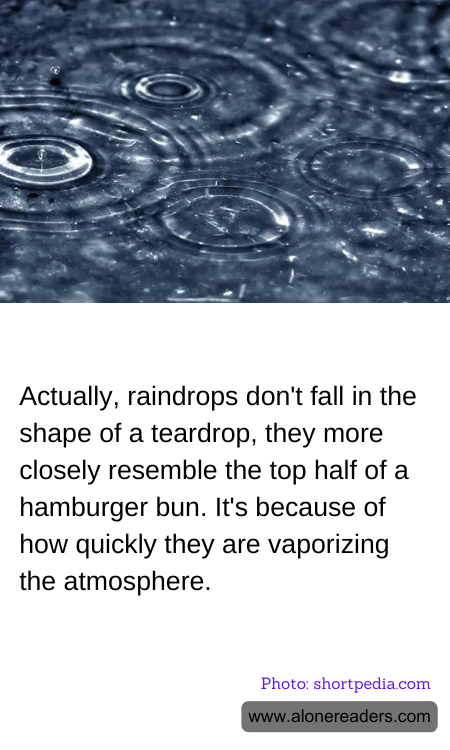
When we think of raindrops, the image that often comes to mind is that of a teardrop, a shape that has been popularized by countless illustrations and animations. However, the reality of a raindrop's shape is quite different and far more intriguing. In truth, raindrops more closely resemble the top half of a hamburger bun, a shape dictated by the forces they encounter as they fall through the atmosphere.
The misconception of raindrops being teardrop-shaped likely stems from the way water droplets form on surfaces, such as the tip of a leaf or the edge of a faucet. In these scenarios, surface tension pulls the water into a shape that is narrow at the top and wider at the bottom, resembling a teardrop. However, once a raindrop is airborne, it is subject to different forces that alter its shape.
As raindrops fall from clouds, they encounter air resistance, which plays a significant role in shaping them. Initially, small raindrops are nearly spherical due to surface tension. However, as they grow larger and fall faster, the air pressure beneath them increases. This pressure flattens the bottom of the raindrop, creating a shape that is more akin to a hamburger bun. The top remains rounded, while the bottom becomes flatter, sometimes even slightly indented, depending on the size of the raindrop.
The transformation of raindrops as they fall is also influenced by their interaction with the atmosphere. As they descend, raindrops can begin to evaporate, especially in dry conditions. This evaporation process can cause the raindrop to lose mass and change shape, further contributing to the hamburger bun-like appearance. The larger the raindrop, the more pronounced these effects become, as larger drops fall faster and experience greater air resistance.
Understanding the true shape of raindrops not only satisfies our curiosity but also has practical implications. For meteorologists and scientists, accurately modeling raindrop shapes is crucial for predicting weather patterns and understanding precipitation dynamics. It also plays a role in the design of radar systems used to measure rainfall, as the shape and size of raindrops affect how they scatter radar signals.
In conclusion, while the romanticized image of a teardrop-shaped raindrop is appealing, the reality is that raindrops are more like the top half of a hamburger bun. This shape is a result of the complex interplay between surface tension, air resistance, and evaporation as raindrops journey from the clouds to the ground. By appreciating the true form of raindrops, we gain a deeper understanding of the natural world and the fascinating processes that govern it.
