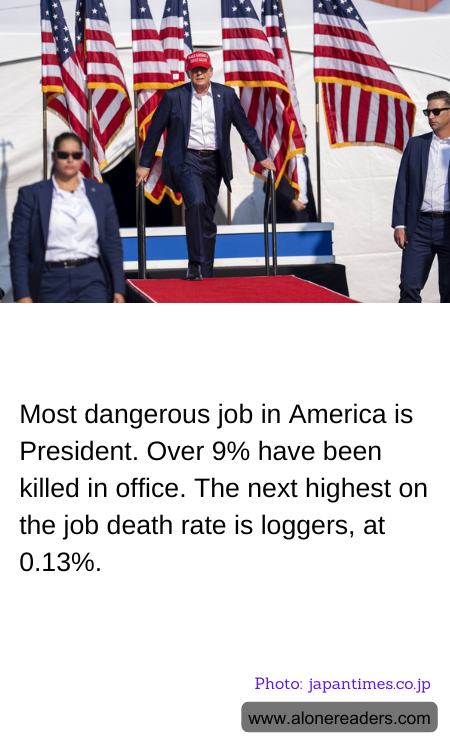
When considering the most dangerous jobs in America, images of loggers wielding chainsaws or deep-sea fishermen battling the elements might come to mind. However, a surprising contender tops the list: the President of the United States. With over 9% of U.S. Presidents having been assassinated while in office, this role carries a risk far exceeding that of any other occupation in the country. In stark contrast, the next highest on-the-job death rate belongs to loggers, at a mere 0.13%.
The presidency, often seen as the pinnacle of political achievement, comes with immense responsibilities and pressures. The role requires navigating complex domestic and international issues, making decisions that impact millions, and maintaining a public persona under constant scrutiny. Yet, the most perilous aspect of the job is the potential for assassination. Four out of the 46 U.S. Presidents have been killed while serving: Abraham Lincoln, James A. Garfield, William McKinley, and John F. Kennedy. This statistic underscores the unique dangers associated with being the leader of the free world.
The reasons behind these assassinations are varied, often reflecting the turbulent political climates of their times. Lincoln was killed shortly after the Civil War, a period marked by deep national divisions. Garfield and McKinley were victims of disgruntled individuals with political grievances, while Kennedy's assassination remains a subject of extensive speculation and conspiracy theories. These tragic events highlight the vulnerability of those in power and the extreme measures some individuals might take to express dissent.
In comparison, the logging industry, known for its physical demands and hazardous working conditions, has a significantly lower fatality rate. Loggers face daily risks from falling trees, heavy machinery, and remote work environments, yet their death rate is a fraction of that faced by U.S. Presidents. This stark difference emphasizes the unique nature of the threats faced by political leaders, which are often driven by ideological motives rather than occupational hazards.
The high risk associated with the presidency raises important questions about the security measures in place to protect national leaders. Over the years, the Secret Service has evolved its strategies to ensure the safety of the President, employing advanced technology and rigorous protocols. Despite these efforts, the inherent risks of the role remain, as the President is a symbol of national power and a target for those seeking to make a statement.
In conclusion, while many jobs in America come with their own set of dangers, the presidency stands out as the most perilous due to its unique combination of political, social, and personal risks. The history of presidential assassinations serves as a sobering reminder of the sacrifices and dangers that accompany the highest office in the land. As society continues to evolve, so too must the measures to protect those who serve, ensuring that the role of President remains one of leadership and inspiration, rather than peril.
