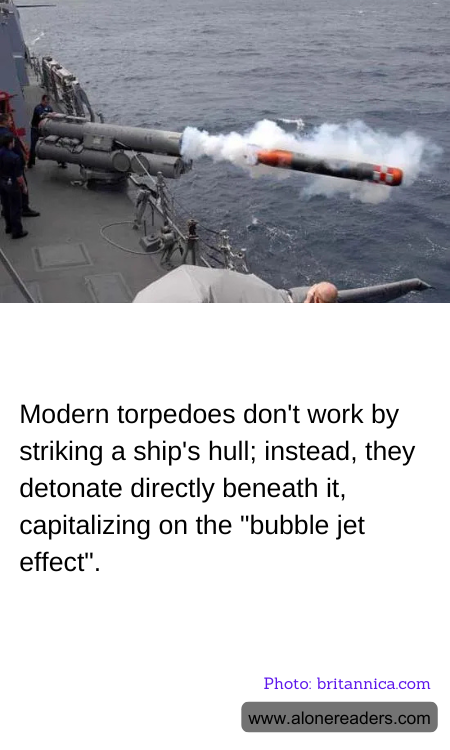
In the realm of naval warfare, technological advancements have continuously reshaped strategies and tactics, with modern torpedoes standing as a testament to this evolution. Unlike their predecessors, which relied on direct impact with a ship's hull to inflict damage, contemporary torpedoes employ a more sophisticated and devastating mechanism known as the "bubble jet effect." This innovative approach has revolutionized how naval forces engage enemy vessels, enhancing both the effectiveness and lethality of underwater weaponry.
The bubble jet effect is a phenomenon that occurs when a torpedo detonates beneath a ship, rather than upon direct contact with its hull. This method leverages the physics of underwater explosions to create a powerful upward force. When a torpedo explodes beneath a ship, it generates a massive gas bubble. As this bubble expands and contracts, it exerts immense pressure on the ship's hull from below. The rapid expansion and subsequent collapse of the bubble create a shockwave that can break the ship's keel, the structural backbone, effectively splitting the vessel in two or causing it to sink rapidly.
This approach offers several advantages over traditional impact-based torpedoes. By detonating beneath the ship, the torpedo avoids the heavily armored sides of modern naval vessels, which are designed to withstand direct hits. Instead, it targets the more vulnerable underside, where the structural integrity is less fortified. This not only increases the likelihood of a successful strike but also maximizes the damage inflicted, often rendering the ship irreparable or sinking it outright.
The bubble jet effect also enhances the stealth and efficiency of torpedo attacks. Since the torpedo does not need to make physical contact with the hull, it can be detonated at a precise depth and distance, reducing the chances of detection and interception by the target's defensive systems. This allows naval forces to engage enemy ships from a safer distance, minimizing the risk to their own assets while maintaining a high probability of success.
As naval technology continues to advance, the principles underlying the bubble jet effect are likely to be further refined and integrated into future generations of torpedoes. This ongoing innovation underscores the importance of understanding and adapting to new methods of warfare, ensuring that naval forces remain equipped to meet the challenges of modern combat. The bubble jet effect not only exemplifies the ingenuity of contemporary military engineering but also highlights the ever-evolving nature of naval strategy in the 21st century.
