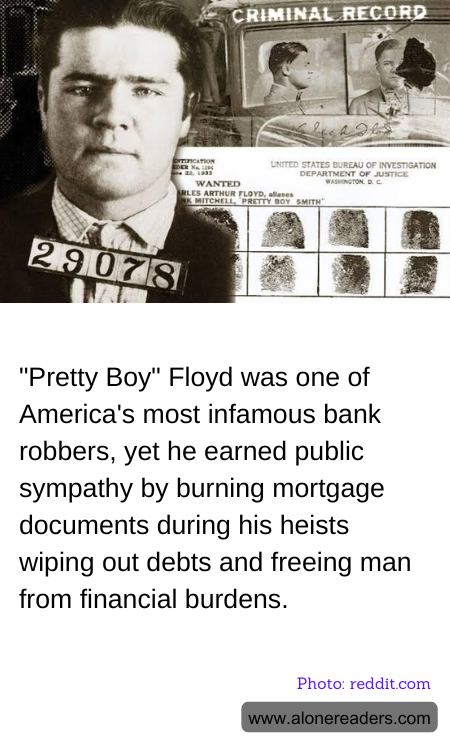
Charles Arthur "Pretty Boy" Floyd, a name that resonates with the tumultuous era of the Great Depression, was one of America's most notorious bank robbers. Yet, unlike many of his contemporaries, Floyd managed to capture the public's imagination and sympathy, not just for his audacious heists but for his unexpected acts of generosity during a time of widespread financial despair.
Born in 1904 in Georgia and raised in Oklahoma, Floyd's early life was marked by poverty and hardship. These formative years in the rural heartland of America shaped his views and actions, particularly during the economic collapse of the 1930s. As banks foreclosed on farms and homes, leaving countless families destitute, Floyd emerged as a modern-day Robin Hood, albeit one with a criminal edge.
Floyd's bank robberies were legendary, not only for their boldness but for the peculiar twist he often added. During several of his heists, Floyd reportedly burned mortgage documents, effectively erasing the debts of struggling farmers and homeowners. This act of defiance against financial institutions endeared him to many who saw banks as the villains of the Depression era. For those burdened by debt, Floyd was not just a criminal but a liberator, a man who dared to stand against the system that had failed them.
The media of the time played a significant role in shaping Floyd's image. Newspapers and radio broadcasts often portrayed him as a folk hero, a man who, despite his criminal activities, had a moral compass that aligned with the struggles of the common people. This narrative was further fueled by Floyd's own disdain for violence against ordinary citizens, as he was known to avoid harming bystanders during his robberies.
Despite his popularity among the public, Floyd's life was fraught with danger and pursuit by law enforcement. His criminal activities eventually caught up with him, and in 1934, he was shot and killed by FBI agents in Ohio. His death marked the end of an era, but his legend lived on, immortalized in songs, stories, and the collective memory of a nation grappling with economic hardship.
"Pretty Boy" Floyd's story is a complex tapestry of crime, compassion, and rebellion. While his methods were undoubtedly illegal, his actions highlighted the desperation and disillusionment of a generation. In a world where financial institutions were often seen as oppressive forces, Floyd's symbolic destruction of debt resonated deeply, offering a glimmer of hope and justice to those who felt powerless. His legacy serves as a reminder of the profound impact of economic inequality and the lengths to which individuals might go to challenge it.
