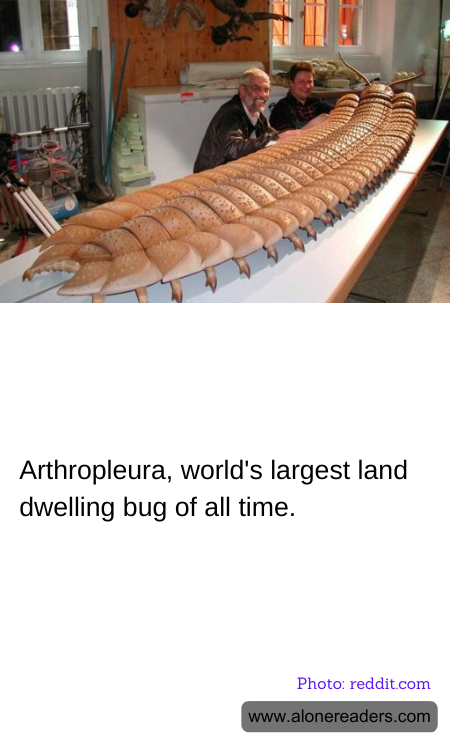
In the lush, verdant landscapes of the Carboniferous period, approximately 300 million years ago, a creature of colossal proportions roamed the earth. This creature, known as Arthropleura, holds the title of the largest land-dwelling arthropod to have ever existed. Stretching up to 2.5 meters (about 8 feet) in length, Arthropleura was a giant among its contemporaries, a testament to the unique environmental conditions of its time.
Arthropleura belonged to the group of invertebrates known as myriapods, which includes modern-day centipedes and millipedes. However, unlike its smaller relatives, Arthropleura was a true giant. Its elongated body was composed of numerous segments, each protected by a hard exoskeleton. This formidable armor not only provided defense against predators but also supported its massive size. The creature's numerous legs, possibly numbering in the hundreds, allowed it to navigate the dense undergrowth of prehistoric forests with surprising agility.
The Carboniferous period, often referred to as the "Age of Amphibians," was characterized by warm, humid climates and vast swampy forests. These conditions were ideal for the proliferation of plant life, which in turn supported a diverse array of herbivorous creatures. Arthropleura thrived in this environment, feeding primarily on the abundant plant material. Its diet likely consisted of decaying vegetation, which was plentiful in the thick, leaf-littered forest floors. This abundance of food, coupled with high oxygen levels in the atmosphere, contributed to the extraordinary size of Arthropleura and other arthropods of the era.
Despite its intimidating size, Arthropleura was not a predator. Its mouthparts were adapted for a herbivorous diet, and there is no evidence to suggest it posed a threat to other large animals of its time. Instead, it likely played a crucial role in the ecosystem as a decomposer, breaking down plant material and contributing to the nutrient cycle within its habitat.
The decline of Arthropleura coincided with the end of the Carboniferous period, as the Earth's climate began to shift. The drying of swamps and the reduction of atmospheric oxygen levels made it increasingly difficult for such large arthropods to survive. By the Permian period, Arthropleura had vanished, leaving behind only fossilized remains to tell the story of its existence.
Today, the legacy of Arthropleura continues to captivate scientists and enthusiasts alike. Its fossils provide invaluable insights into the prehistoric world and the evolutionary history of arthropods. As we uncover more about this fascinating creature, we gain a deeper understanding of the complex interplay between life and the environment over the millennia. Arthropleura stands as a remarkable example of nature's ability to produce extraordinary life forms, reminding us of the rich tapestry of life that has existed on our planet long before humans walked the Earth.
