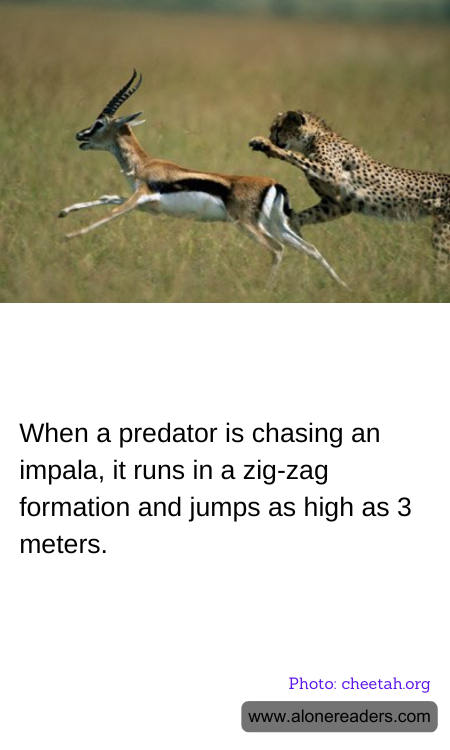
In the vast savannas of Africa, where the circle of life plays out in its most raw and unfiltered form, the impala stands as a testament to nature's ingenuity in survival. These graceful antelopes, known for their agility and speed, have developed a fascinating strategy to evade predators: a zig-zag running pattern combined with impressive leaps that can reach up to three meters high. This behavior is not just a spectacle of athleticism but a crucial survival tactic in the predator-prey dynamic.
When a predator, such as a lion or cheetah, sets its sights on an impala, the chase is on. The impala's immediate response is to flee, but not in a straightforward manner. Instead, it employs a zig-zag pattern, a technique that serves multiple purposes. This erratic movement makes it difficult for the predator to predict the impala's path, reducing the likelihood of a successful capture. The zig-zagging also allows the impala to maintain its speed while constantly changing direction, a maneuver that can quickly tire out a pursuing predator that relies on short bursts of speed.
In addition to zig-zagging, impalas are known for their remarkable jumping ability. These leaps, often reaching heights of three meters, are not just random displays of power. They serve as a strategic advantage in several ways. Firstly, jumping allows the impala to clear obstacles that might slow down a predator, such as bushes or uneven terrain. Secondly, the sudden vertical movement can confuse and disorient the predator, momentarily breaking its focus and giving the impala a crucial second to gain distance. Lastly, these jumps can signal to other impalas in the herd, alerting them to the presence of danger and prompting a collective escape.
The impala's survival tactics highlight the intricate balance of nature, where every creature has evolved unique adaptations to thrive in its environment. For the impala, the combination of speed, agility, and strategic movement is its best defense against the relentless threats of the wild. This behavior not only ensures the survival of individual impalas but also plays a role in maintaining the ecological balance, as predators are forced to hone their skills and adapt to the challenges posed by such agile prey.
In observing the impala's flight from predators, one can appreciate the elegance and complexity of nature's design. It is a reminder of the constant dance between predator and prey, where each has its role and each must continuously adapt to survive. The impala's zig-zagging and high jumps are more than just survival tactics; they are a testament to the resilience and resourcefulness that define life in the wild.
