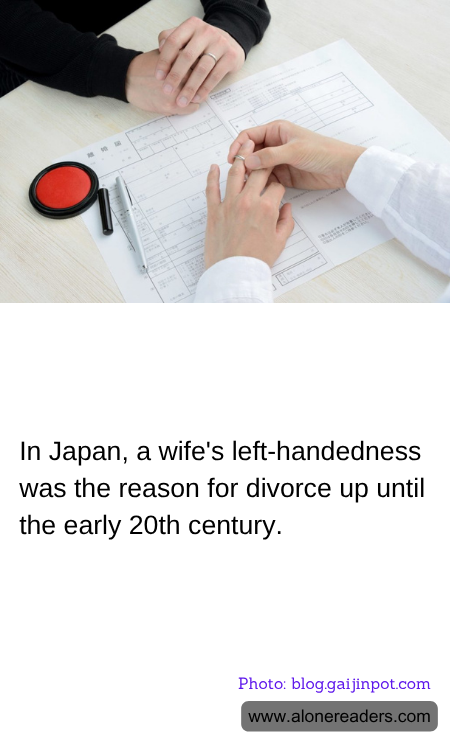
In the rich tapestry of Japan's cultural history, there are many fascinating and sometimes perplexing customs that have evolved over time. One such custom, which may seem peculiar to modern sensibilities, is the historical stigma attached to left-handedness, particularly among women. Up until the early 20th century, a wife's left-handedness could be considered a legitimate reason for divorce in Japan. This practice, rooted in cultural beliefs and societal norms, offers a window into the complexities of tradition and the evolution of social values.
The preference for right-handedness in Japan, as in many other cultures, has deep historical roots. Traditionally, the right hand was associated with positive attributes, while the left was often linked to the opposite. This bias is reflected in language, where the word for "left" (hidari) can be traced back to a term meaning "unlucky" or "inferior." Such linguistic associations reinforced societal attitudes, making left-handedness a trait to be corrected or concealed.
In the context of marriage, these cultural biases had significant implications. A left-handed wife was often seen as a deviation from the norm, which could bring shame or dishonor to a family. The societal pressure to conform to right-handedness was immense, and failure to do so could be perceived as a lack of discipline or an unwillingness to adhere to traditional roles. In a society where harmony and conformity were highly valued, a left-handed wife could be viewed as a source of discord, justifying divorce in the eyes of some.
The emphasis on right-handedness was not merely a matter of personal preference but was intertwined with practical aspects of daily life. Traditional Japanese customs, such as the art of calligraphy, tea ceremonies, and the use of chopsticks, were all designed with right-handed individuals in mind. A left-handed person might struggle with these practices, further highlighting their difference and potentially causing embarrassment in social settings.
As Japan modernized and Western influences began to permeate its culture, attitudes towards left-handedness gradually shifted. The rigid adherence to right-handed norms softened, and the stigma associated with being left-handed diminished. Education and increased awareness played crucial roles in this transformation, as did the broader societal changes that accompanied Japan's rapid modernization.
Today, left-handedness is no longer a cause for divorce in Japan, and the practice is largely viewed as an outdated relic of the past. The journey from stigmatization to acceptance reflects broader changes in Japanese society, where individuality and diversity are increasingly celebrated. While the historical bias against left-handedness may seem strange to contemporary observers, it serves as a reminder of the ever-evolving nature of cultural norms and the importance of understanding the context in which they arise.
In examining this aspect of Japan's history, we gain insight into the complex interplay between tradition and change, and the ways in which societies adapt to new realities. The story of left-handedness in Japan is a testament to the resilience of cultural practices and the capacity for societies to grow and evolve over time.
