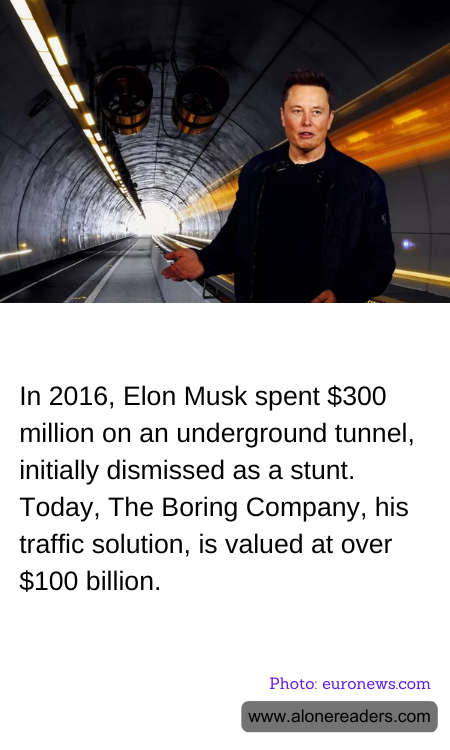
In 2016, when Elon Musk announced his ambitious plan to build an underground tunnel system to alleviate traffic congestion, many skeptics dismissed it as yet another extravagant stunt by the tech mogul. Musk, known for his ventures in electric vehicles and space exploration, was venturing into uncharted territory with The Boring Company. The initial investment of $300 million seemed like a gamble, especially given the skepticism surrounding the feasibility and practicality of such a project. However, fast forward to today, and The Boring Company has not only silenced its critics but has also emerged as a groundbreaking solution to urban traffic woes, with a valuation soaring over $100 billion.
The Boring Company's journey from a seemingly whimsical idea to a multi-billion-dollar enterprise is a testament to Musk's vision and determination. The core concept was simple yet revolutionary: create a network of underground tunnels that could transport vehicles at high speeds, bypassing the gridlock that plagues major cities. This idea, while not entirely new, had never been executed on such a scale or with such technological innovation. Musk's approach involved using advanced tunneling machines to drastically reduce the cost and time required to dig tunnels, making the project economically viable.
The first major breakthrough came with the successful completion of a test tunnel in Hawthorne, California, which demonstrated the potential of the technology. This was followed by the development of the Las Vegas Convention Center Loop, a 1.7-mile underground transportation system that opened to the public in 2021. The Loop, which uses Tesla vehicles to shuttle passengers, has been praised for its efficiency and has sparked interest from other cities looking to implement similar systems.
The success of these projects has fueled The Boring Company's rapid growth and attracted significant investment. Cities across the United States and around the world are now exploring partnerships with the company to develop their own underground transportation networks. The potential applications are vast, from reducing commute times and lowering carbon emissions to transforming urban planning and infrastructure development.
The Boring Company's rise to prominence is not just a story of technological innovation but also a reflection of changing attitudes towards urban transportation. As cities continue to grow and traffic congestion worsens, there is an increasing demand for sustainable and efficient solutions. The Boring Company's tunnels offer a glimpse into a future where urban mobility is reimagined, and the daily grind of traffic jams becomes a thing of the past.
In conclusion, what began as a seemingly outlandish idea has evolved into a transformative force in urban transportation. The Boring Company's success underscores the importance of visionary thinking and the willingness to challenge conventional norms. As the company continues to expand its reach and refine its technology, it stands as a beacon of innovation, proving that with the right mix of ambition and ingenuity, even the most daunting challenges can be overcome.
