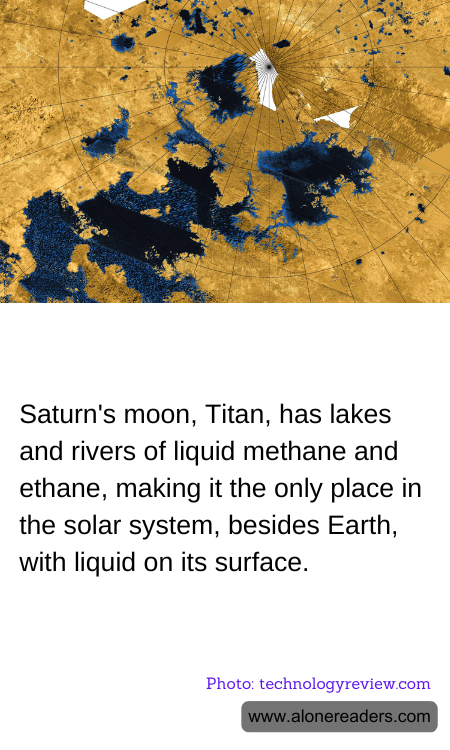
Saturn's moon, Titan, stands out as one of the most intriguing celestial bodies in our solar system. It is the only place, apart from Earth, known to have stable bodies of liquid on its surface. However, unlike Earth, where water fills our lakes and rivers, Titan's liquid bodies are composed of methane and ethane. This fascinating feature makes Titan a subject of great interest for scientists and space enthusiasts alike.
Titan's thick, nitrogen-rich atmosphere is similar to what scientists believe Earth's atmosphere might have been like in its early days. This dense atmosphere, combined with its frigid temperatures, allows methane and ethane to exist in liquid form. The surface of Titan is dotted with vast lakes and rivers, primarily concentrated around its polar regions. The largest of these, Kraken Mare, is a sea that spans over 1,000 kilometers across, making it larger than some of Earth's great lakes.
The presence of these liquid hydrocarbons on Titan opens up a world of possibilities for scientific exploration. The Cassini-Huygens mission, which provided much of our current knowledge about Titan, revealed that these lakes and rivers undergo cycles similar to Earth's water cycle. Methane evaporates, forms clouds, and precipitates back onto the surface as rain, carving out river channels and filling lakes. This cycle suggests that Titan is a dynamic world, with processes that could potentially support some form of life, albeit very different from life as we know it.
Exploring Titan's lakes and rivers could offer insights into prebiotic chemistry and the conditions that might lead to life. The moon's unique environment serves as a natural laboratory for studying the chemistry of organic molecules in conditions that are vastly different from those on Earth. Future missions, such as NASA's Dragonfly drone, aim to delve deeper into Titan's mysteries, exploring its surface and atmosphere to gather more data.
Titan's liquid methane and ethane lakes and rivers not only make it a captivating subject for scientific study but also fuel the imagination about the possibilities of life beyond Earth. As we continue to explore our solar system, Titan remains a beacon of curiosity, challenging our understanding of what makes a world habitable. Its alien yet familiar landscapes remind us of the diversity and wonder that exist beyond our home planet, urging us to look up and explore the cosmos.
